
Last Updated: October 26, 2026
Quick Summary
You can identify sick trees by checking four zones: leaves, branches, trunk, and roots. Damage in two or more zones usually points to serious tree decline, while one zone alone is often treatable. Watch for wilting, yellowing, branch dieback, bark cracks, oozing sap, and mushrooms at the base.
- A tree that looks bad from top to bottom is in real trouble, not just stressed.
- Scratch a twig with a fingernail: green underneath means alive, brown and dry means dead.
- Symptoms on one side only often trace to root damage or a wound, not whole-tree disease.
- Keep people and pets clear of a tree with a new lean, deep trunk cracks, or hanging dead limbs.
- Walk your yard four times a year and photograph the same views for comparison.
Table of Contents
- Start With a Walk-Through: The First Signs of a Sick Tree
- How to Tell If a Tree Is Dying: A Symptom-by-Symptom Check
- Common Tree Diseases and Symptoms You’ll See in a Yard
- Pests, Fungi, and Root Problems: What’s Really Causing the Decline
- Should You Use a Tree Disease Identification App?
- Build a Season-by-Season Inspection Checklist
- When to Call a Professional for a Sick Tree
- Get a Custom Quote for Tree Care and Yard Restoration
- Frequently Asked Questions
Start With a Walk-Through: The First Signs of a Sick Tree
Learning how to identify sick trees in your yard starts with one slow lap around the property. Most sick trees show warning signs weeks or months before serious damage sets in. A tree in trouble rarely hides it well.
Here is the key idea most guides skip: a single odd leaf means little. Patterns matter. A tree that looks bad in one spot is often just stressed.
What Healthy Looks Like vs. What’s Actually Wrong
A healthy tree has even foliage, firm bark, and new growth at the tips each spring. The canopy should look full from every angle.
Watch for these early warning signs of a sick tree:
- Leaves that droop during mild weather
- Bare patches in the canopy where sun gets through
- Bark that feels soft or crumbles under a fingernail
That last one surprises people. A tree pushing growth from its base is often trying to survive after the top has failed.
Normal Seasonal Changes That Mimic Disease
Not every brown leaf means tree disease. Some trees drop leaves early in dry spells and recover fine. Evergreens shed older needles from the inside out, which looks alarming but is normal.
The difference comes down to timing and pattern:
- Seasonal change hits the whole tree evenly and on schedule
- Disease hits one side, one branch, or the newest growth first
- Normal fall color fades gradually; sudden browning in summer does not
How to Tell If a Tree Is Dying: A Symptom-by-Symptom Check
The fastest way to tell if a tree is dying is to check four zones: leaves, branches, trunk, and roots. Damage in two or more zones usually points to serious tree decline. One zone alone is often treatable.
Foliage Clues: Wilting, Yellowing, Spots, and Curling
Leaves tell you the most, the soonest. Wilting leaves in cool weather signal a water problem, either too little or roots that cannot absorb it. Yellow leaves on a normally green tree point to nutrient issues or root damage.
Look closely at the leaf surface:
- Dark spots or blotches suggest fungal growth
- Curling or distorted leaves often mean pest damage
- Sticky residue or oozing sap on leaves points to insects
Branch and Trunk Clues: Dieback, Cracks, and Oozing Sap
Branch dieback is the clearest sign of a sick tree. Dead branches hold no leaves and snap easily. Scratch a twig with a fingernail: green underneath means alive, brown and dry means dead.
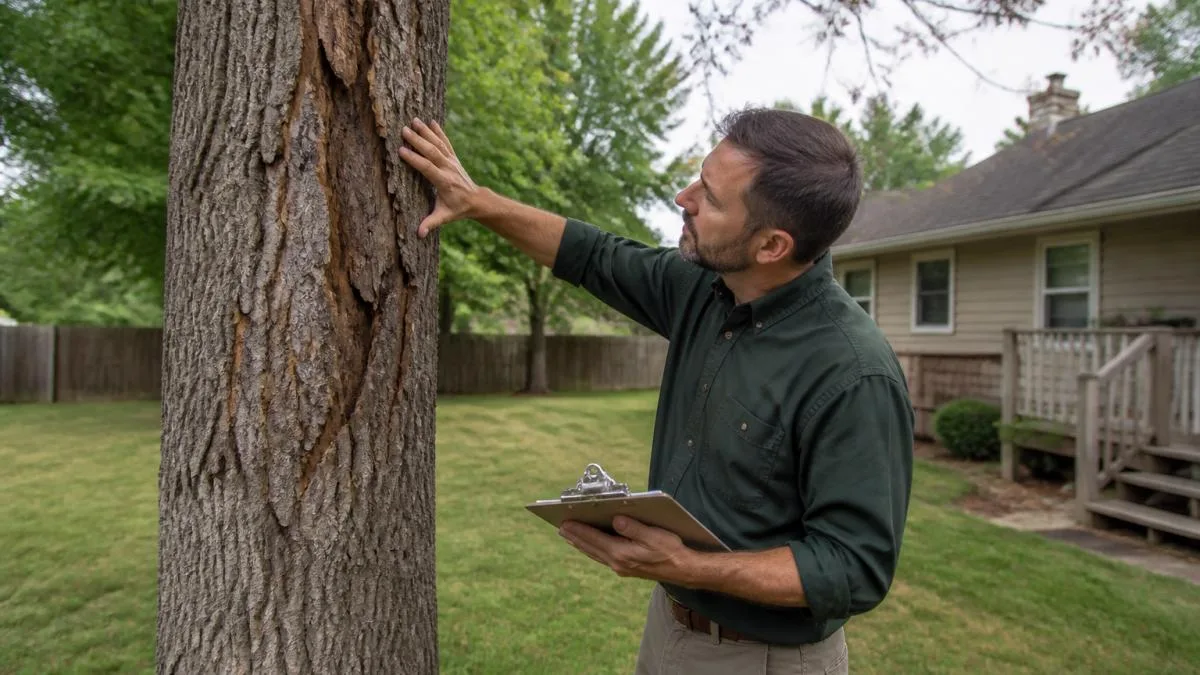
On the trunk, check for bark damage and splitting. Vertical cracks, soft spots, or mushrooms growing from the base all suggest root decay or internal rot. Oozing sap on the trunk is another warning, often tied to pests or infection.
A Simple Symptom-to-Cause Diagnostic Guide
Most guides stop at listing symptoms. The useful next step is matching what you see to the most likely cause, then deciding whether to watch, treat, or call. Use this guide as a starting point, not a final diagnosis.
| What You See | Most Likely Cause | What to Do Next |
|---|---|---|
| Wilting in cool, moist weather | Root or vascular problem | Check soil moisture; call if wilting spreads |
| Yellow leaves between green veins | Nutrient deficiency or soil pH issue | Soil test before fertilizing |
| Dark spots spreading bottom-up | Fungal leaf spot | Remove fallen leaves; improve airflow |
| Sticky residue and curled new growth | Aphids or scale insects | Monitor; treat small infestations |
| Sawdust-like frass at the base | Borers or carpenter ants | Call a professional; do not ignore |
| Mushrooms at the base plus thinning canopy | Root rot | Have the tree assessed for stability |
| Vertical cracks and soft bark | Internal decay or frost damage | Keep people away; get an assessment |
| One-sided dieback | Root damage, canker, or physical injury | Note the pattern and monitor weekly |
Two patterns deserve special attention. First, symptoms that appear on one side only often trace to root damage or a wound on that side, not to a whole-tree disease. Second, symptoms that move from the top down usually indicate a vascular problem, while symptoms that move from the bottom up are more often fungal.
Urgency Triage: When to Keep People Away
Some signs are not cosmetic. Treat these as immediate hazards and keep people and pets clear of the area:
- A new lean that was not there last season
- Deep vertical cracks or splitting in the main trunk
- Large dead limbs hanging over a roof, driveway, or play area
For these, do not attempt to fix the tree yourself. Call a qualified arborist for an assessment. A common pattern is for homeowners to wait a full season to see if the tree recovers; with hazard signs, waiting is the wrong move.
Common Tree Diseases and Symptoms You’ll See in a Yard
Common tree diseases and symptoms vary by species, but a few patterns repeat across most yards. Leaf spots, powdery coatings, and sudden wilting top the list.
Fungal issues thrive in damp, shaded spots. They spread through wet foliage, so trees packed too close together suffer most.
Watch for these recurring issues:
- Leaf spot diseases that spread from the bottom up
- Powdery mildew on new growth in humid weather
- Cankers, which are sunken dead patches on branches
The university extension guides on tree disease are a solid free reference for matching symptoms to specific species.
Pests, Fungi, and Root Problems: What’s Really Causing the Decline
Insects and fungi often work together. Pests weaken a tree, then fungus moves in.
Root problems are the hardest to spot because they hide underground. Signs include a thinning canopy with no clear cause, mushrooms near the trunk, and soil that stays soggy.
If you spot active insect damage or spreading fungal growth, our pest management service handles the treatment side.
Should You Use a Tree Disease Identification App?
A tree disease identification app can help narrow down possibilities, but treat it as a starting point, not a verdict. Apps match photos to databases. They cannot feel bark, check soil, or see the whole tree.
Use an app to log photos and track changes over time. The U.S. Forest Service guidance on tree health backs this up: accurate diagnosis needs context an app cannot capture.
Build a Season-by-Season Inspection Checklist
A repeatable checklist beats guesswork. Walk your yard four times a year and check the same things each time. Photo documentation makes this far more useful, since you can compare this season to last.
Use this checklist:
- Spring: Check for new growth at branch tips and any bare patches
- Spring: Look for holes, frass, or sticky residue on trunks
- Summer: Note wilting, yellow leaves, or spots during dry spells
For deeper guidance on caring for specific plants as you build this routine, see our guide to maintaining specific garden plant types.
| Season | What to Check | Warning Sign | Action |
|---|---|---|---|
| Spring | New growth, trunk pests | Bare tips, small holes | Monitor weekly |
| Summer | Leaves, canopy density | Wilting, thinning top | Check water and roots |
| Fall | Leaf drop timing | Early drop, spots | Bag fallen leaves |
| Winter | Bark, dead branches | Cracks, soft spots | Call a pro if widespread |
When to Call a Professional for a Sick Tree
Call a professional when damage shows in two or more zones, when large dead branches hang over structures, or when the trunk has deep cracks. These are safety issues, not just cosmetic ones. A failing tree near a house or driveway is a real hazard.
What Homeowners Can Safely Do
You can inspect, document, and make small adjustments without special training:
- Walk the yard each season and photograph the same views for comparison
- Check soil moisture by hand before watering
- Rake and bag fallen leaves to reduce fungal spread
What to Leave to a Professional
Some tasks carry real risk or require diagnostic training:
- Removing limbs larger than your arm or any limb near power lines
- Climbing the tree or working from a ladder at height
- Applying pesticides or fungicides
Questions to Ask Before You Hire
A short list of questions separates qualified help from guesswork:
- Are you licensed and insured for tree work in this state?
- Do you carry liability coverage for property damage?
- Will you provide a written assessment of the tree’s condition?
Small problems you can watch yourself. Big ones need trained eyes. Our tree care team diagnoses the cause and treats what is treatable, and we remove what is not.
Get a Custom Quote for Tree Care and Yard Restoration
Every yard is different, so we quote each job on its own. You can get a Custom Quote to request a quote and get a clear plan.
If dying trees have left bare spots, dead grass, or debris behind, our yard restoration services cover cleanup and replanting. We handle tree care, pest control, and lawn work under one roof, so you are not coordinating multiple contractors.
Frequently Asked Questions
What does a diseased tree look like?
A diseased tree usually shows a cluster of symptoms rather than one isolated problem. Look for yellow or brown leaves outside of normal seasonal change, leaf spots, curling or distorted growth, a thinning canopy, and premature leaf drop. On the trunk and branches, watch for bark splitting, cracks, oozing sap, or sticky residue. Fungal growth such as mushrooms at the base or mold on bark is another red flag. One symptom alone may be normal stress; three or more together usually point to a sick tree that needs a closer look.
How can I tell if my tree is sick or dying?
Start with the scratch test on a few small twigs: if the layer under the bark is green and moist, that branch is still alive, and if it is brown and dry, it is dead. Then check the canopy for thinning, branch dieback, and dead branches that snap easily. Look at the trunk for cracks, oozing sap, or sawdust-like frass near small holes. A tree with more than about 30 percent dead canopy, or one leaning with exposed roots, is in serious decline and should be assessed by a professional.
What is the best free app for identifying tree diseases?
Several free plant identification apps can help you narrow down a suspect tree disease by photo, but treat the result as a starting point, not a diagnosis. Apps work best when you photograph clear close-ups of affected leaves, bark, and any fungal growth in good daylight. Accuracy drops for diseases that look alike or for problems rooted in soil and roots, which never show up in a leaf photo. Use a tree disease identification app to organize your notes and photos, then confirm with a professional before treating anything.
When should I call an arborist about a sick tree?
Call a professional when the trunk has large cracks or cavities, when the tree is leaning or has exposed roots, when more than a quarter of the canopy is dead, or when a large dead limb hangs over a house, driveway, or power line. Also call if you cannot match the symptoms to a cause after a week of monitoring, or if the tree is one you want to keep.
Your trees will not tell you when they are in trouble. They show you, quietly, season after season. The homeowners who catch decline early spend less and lose fewer trees. Clean Cut Property Maintenance offers full-service tree care, pest management, and yard restoration, with a custom quote process built around your property and one team handling all of it. Get started with Clean Cut Property Maintenance and give your yard the expert care it needs.
