
Last Updated: October 23, 2026
Quick Summary
A lawn fertilization schedule for cool season grass follows the plant’s growth clock: feed once in spring once growth is underway, hold off on nitrogen during summer heat, then make early-fall and late-fall winterizer applications the priority. Most cool season grass lawns do best with three to four feedings per year, timed to active growth rather than spread evenly across the calendar.
- Wait for soil at 2 inches near 55°F and rising before spring feeding.
- Skip or keep summer nitrogen light once soil climbs above roughly 75°F.
- Apply a September feeding and an October-November winterizer for root storage.
- Target roughly 0.5 to 1.0 pound of actual nitrogen per 1,000 square feet per application.
- Skip feeding before forecast heavy rain and delay during drought or heat waves.
Table of Contents
- Why Cool-Season Grass Needs a Different Fertilization Schedule
- Your Cool-Season Lawn Fertilizer Schedule by Month
- How Often to Fertilize a Cool-Season Lawn
- The Best Fertilizer for Cool-Season Grass
- Cool-Season Grass Fertilizer Application Rate: Getting the Numbers Right
- Adjusting the Schedule for Soil Tests, Weather, and New Seedings
- Watering, Runoff, and Common Timing Mistakes to Avoid
- Conclusion
- Frequently Asked Questions
Why Cool-Season Grass Needs a Different Fertilization Schedule
A lawn fertilization schedule for cool season grass follows the plant’s growth clock, not the calendar, and that holds true for every cool season grass lawn. Cool-season grasses such as tall fescue, Kentucky bluegrass, and perennial ryegrass grow most vigorously in spring and fall, slow in summer heat, and go dormant in winter.
Get the timing wrong and you push tender growth into summer stress or waste fertilizer when roots aren’t active.
Growth Cycles: Spring Green-Up, Summer Stress, and Fall Recovery
Cool-season grass thrives in cooler temperatures and does most of its growing in spring and fall. Spring green-up marks the start of active growth as the lawn wakes from dormancy. Summer is the stress period: heat slows growth and root development shifts below the surface.
Feed during active growth, hold back during heat stress, and lean into fall when the grass prepares for dormancy.
Cool-Season vs. Warm-Season Grasses: Why Timing Diverges
Warm-season grasses like Bermuda and zoysia peak in midsummer and go dormant in cool weather; cool-season grasses do the opposite. A schedule built for a warm-season lawn will misfire on a fescue lawn because the feed windows land in different months. For a deeper look, our guide to maintaining specific garden plant types walks through the details.
Your Cool-Season Lawn Fertilizer Schedule by Month
Here is the month-by-month framework with the timing cues that tell you when to pull the trigger. Treat the months as a starting point and adjust for regional climate, soil tests, and weather.
| Window | Months | Goal | Fertilizer Focus | Timing Cue |
|---|---|---|---|---|
| Spring feeding | March-May | Support green-up and early growth | Moderate nitrogen, balanced formula | Soil at 2 inches near 55°F and rising; lawn actively growing |
| Summer holding pattern | June-August | Avoid pushing growth in heat | Little to no nitrogen | Soil above roughly 75°F; heat stress evident |
| Early fall | September | Repair summer damage | Nitrogen plus phosphorus and potassium | Soil cooling back toward 70°F; growth resumes |
| Late fall / winterizer | October-November | Root development and nutrient storage | Slow-release nitrogen | Top growth slowing but grass still green |
March Through May: Spring Feeding
Spring fertilization should wait until the lawn is actively growing and past the first flush of green-up. Feeding too early wastes product and encourages weak top growth.
Species changes the spring call. Kentucky bluegrass spreads aggressively and can be pushed harder in spring, but tall fescue and perennial ryegrass do better with a lighter spring feeding and the real investment saved for fall.
June Through August: Summer Holding Pattern
Summer is when most lawn mistakes happen. Cool-season grass is under heat stress, and pushing nitrogen now forces tender growth that struggles in the heat. Many practitioners skip nitrogen entirely in midsummer and focus on water, mowing height, and weeds instead.
Use growth as your gauge. If the lawn is still pushing new blades and holding color, a light slow-release feeding is defensible; if it has gone off-color and stopped growing, wait.
September Through November: The Fall Window That Matters Most
Fall fertilization is the most important window of the year for cool-season lawns. As temperatures drop, the grass re-enters active growth and shifts energy into root development and nutrient storage.
Species-specific timing pays off in fall. Kentucky bluegrass benefits from both early- and late-fall applications because it rebuilds density through rhizomes. Tall fescue and perennial ryegrass do well on the same two-feed pattern but spread less aggressively, so the late-fall feeding does more of the work.
Adjusting Dates by Region and Weather
The months above are a national average, and the local calendar can shift by weeks. In the transition zone and warmer parts of the cool-season range, spring arrives earlier and fall stays warm longer, so push the fall window later and keep summer nitrogen off until soil cools. In the northern tier, green-up can be delayed into April and the late-fall window can close by late October.
Weather rules of thumb:
- Skip feeding before forecast heavy rain; granules wash off and nutrients leave the root zone.
- Delay applications during drought or heat waves until growth resumes.
- After a dry summer, wait for real fall growth before the early-fall feeding rather than feeding a dormant lawn on the calendar date.
Calendar months are a planning tool; soil temperature, active growth, and the forecast are the actual decision rules. When the two disagree, trust the grass.
How Often to Fertilize a Cool-Season Lawn
Most cool-season lawns do best with three to four feedings per year, timed to the growth windows above rather than spread evenly across the calendar: one spring application, one early-fall application, and one late-fall winterizer, with an optional light summer feeding only if the lawn shows clear need.
Frequency depends on species, soil, and how hard the lawn works. Heavily used lawns and new turf need more attention; established, healthy lawns thrive on fewer applications. If you’d rather not manage timing yourself, our services cover routine feeding as part of a full plan.
The Best Fertilizer for Cool-Season Grass
The best fertilizer for cool-season grass is a slow-release, balanced formula matched to your soil test, not a single “best” bag on the shelf. Slow-release nitrogen feeds gradually, reducing the surge-and-crash cycle of quick-release products and lowering runoff risk.
Look for a sensible nitrogen-phosphorus-potassium ratio for your soil. Our lawn and plant care service matches fertilizer to the specific lawn rather than applying a generic product.
Cool-Season Grass Fertilizer Application Rate: Getting the Numbers Right
The right application rate comes from the product label and your lawn’s size, not guesswork. Most cool-season programs target roughly 0.5 to 1.0 pound of actual nitrogen per 1,000 square feet per application, with the higher end for fall feedings and the lower end for spring or summer touch-ups. That range is a planning target, always confirm against the label rate for the product you bought.
Reading the Bag: Actual Nitrogen and Slow-Release Formulas
The number that matters is actual nitrogen, not the total weight of the bag. Actual nitrogen is the percentage of nitrogen stated on the label applied to the pounds of product you spread. The math is simple:
- Find the first number in the N-P-K ratio (for example, a 24-0-6 bag is 24% nitrogen).
- Multiply the pounds of product by that percentage to get pounds of actual nitrogen.
- Divide by your lawn’s size in thousands of square feet to get actual nitrogen per 1,000 square feet.
A worked example: a 50-pound bag of 24-0-6 contains 12 pounds of actual nitrogen (50 x 0.24). At 4 pounds of product per 1,000 square feet, that delivers about 0.96 pound of actual nitrogen per 1,000 square feet, near the top of the fall target range. Measuring square footage first prevents both under- and over-application.
Slow-release formulas change the timing, not the math. Nitrogen listed as water-insoluble nitrogen (WIN) releases over weeks, so you can often stay at the lower end of the range per feeding. Never exceed the label’s maximum rate, and never stack applications closer than the label’s interval.
Calibrating a Spreader and Avoiding Stripes
Spreader settings on the bag are a starting point, not a guarantee. Calibrate before you treat the whole lawn:
- Measure a test strip, for example, 1,000 square feet (about 20 by 50 feet).
- Weigh out the amount of product the label says that area needs.
- Set the spreader to the bag’s suggested setting, spread the test strip, and weigh what’s left.
- Adjust the setting up or down and repeat until you’re close to the target.
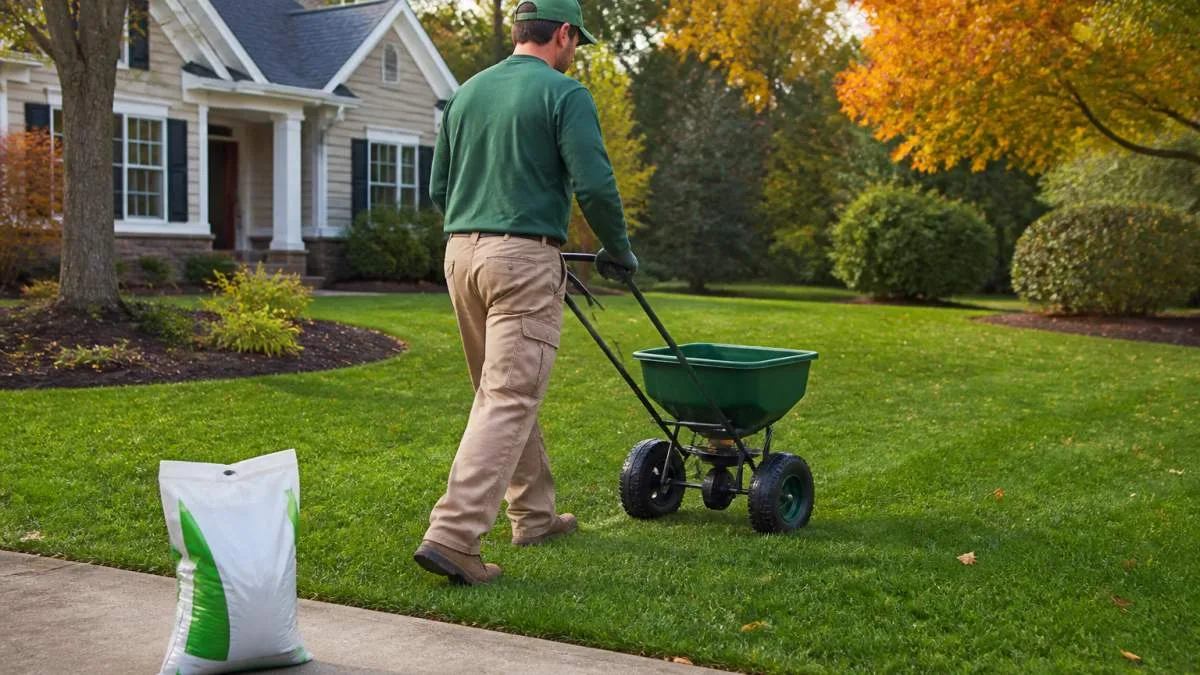
Apply half the product in one direction and half perpendicular to it. This overlap pattern prevents stripes and missed spots that show up weeks later, and it smooths out small errors in spreader output.
Record your spreader setting, product name, and the date for each application. Next season you’ll start from a known-good baseline instead of re-calibrating from scratch.
Matching Rate to Season and Species
Rate should flex with season and species. Spring feedings on Kentucky bluegrass and tall fescue sit at the lower end to avoid pushing tender growth into summer. Early- and late-fall feedings can move toward the higher end because the grass is building roots and storing nutrients. Fine fescues are the exception: lighter feeders that do best at the low end with less total nitrogen across the year.
Adjusting the Schedule for Soil Tests, Weather, and New Seedings
A soil test is the best way to move from a generic schedule to a plan built for your lawn, showing which nutrients are adequate and which need attention.
New seedings and overseeded lawns need their own timing: young grass has shallow roots and needs gentle, frequent feeding with slow-release products once seedlings are established. Our property maintenance team can help with the adjustments.
Watering, Runoff, and Common Timing Mistakes to Avoid
Water after fertilizing to move nutrients into the soil, but avoid overwatering, which carries fertilizer past the root zone into runoff. The most common timing mistakes are feeding too early in spring, pushing nitrogen in summer heat, skipping the late-fall winterizer, and applying before heavy rain.
Applying fertilizer right before a heavy rainstorm washes most of it off the lawn and into storm drains. Check the forecast and wait for a dry window, then water lightly to settle the granules.
Sharpen your spreader settings by applying half the product in one direction and half perpendicular to it. This overlap pattern prevents stripes and missed spots that show up weeks later.
Conclusion
A cool-season lawn rewards timing more than effort, and the fall window does the heaviest lifting. If coordinating spring, summer, and fall applications around weather and soil tests sounds like more than you want to manage, that’s exactly the work we take off your hands. Clean Cut Property Maintenance offers comprehensive residential and commercial services, full-service landscape design and installation, and specialized pest management and tree care, all through a custom quote process built around your property. Reach out through our contact page to get started.
Frequently Asked Questions
When should you fertilize cool-season grass?
The two most important feedings land in early fall (around September) and late fall (around November), when cool-season grass is actively growing and building root reserves. Spring gets a lighter feeding once the lawn has fully greened up, usually late April or May. Summer is generally a holding period: skip nitrogen during heat stress unless you have an irrigation system and are prepared to water consistently.
How many times a year should you fertilize a cool-season lawn?
Most established cool-season lawns do well with three to four feedings per year: a light spring application, one in early fall, one in late fall, and optionally a second fall feeding in October. Lawns on poor soil or with heavy foot traffic may need a fourth. Overseeded or newly established lawns follow a different, gentler schedule until the grass matures.
Can you fertilize cool-season grass in summer?
You can, but it is risky. Cool-season grasses slow their growth in heat, and nitrogen pushes tender top growth that heat and drought stress can kill. If you fertilize in summer, use a low-nitrogen, slow-release product at half the normal rate and water it in promptly. Lawns without irrigation are better off waiting until late summer cools toward fall.
What type of fertilizer is best for cool-season grass?
A slow-release nitrogen formula with a roughly 3-1-2 or 4-1-2 ratio of nitrogen, phosphorus, and potassium suits most cool-season lawns. Slow-release nitrogen feeds gradually and reduces burn risk and runoff. If a soil test shows adequate phosphorus, choose a phosphorus-free blend. Organic options like compost or corn gluten meal work well as part of a fall program.
How much fertilizer should you apply to a cool-season lawn?
Target roughly 0.75 to 1 pound of actual nitrogen per 1,000 square feet per application, and no more than about 3 to 4 pounds of actual nitrogen per 1,000 square feet across the whole year. Divide the nitrogen percentage on the bag into 100 to find how many pounds of product deliver one pound of nitrogen, then measure your lawn area before you spread.
Should you water your lawn after applying fertilizer?
Yes, water lightly right after applying granular fertilizer, about a quarter inch, to move nutrients into the soil and off the blades. Skip watering if heavy rain is forecast within a day, since runoff carries nitrogen into storm drains. On slopes or compacted soil, apply in smaller passes and water gently to keep the product in place.
