
Last Updated: November 1, 2026
Quick Summary
To safely remove weeds from flower beds, water the bed the day before, grip each weed low at the soil line, and pull with a slight twist while supporting nearby flowers. For taproots, slide a weeding fork beside the root and lever it loose instead of pulling straight up, which snaps the root and lets it regrow.
- Identify the weed first, since some regrow from tiny root fragments or scatter seeds when pulled.
- Water the bed the night before weeding, because dry soil makes every tool work twice as hard.
- Apply a 2- to 3-inch mulch layer in most established beds to block light weed seeds need.
- Keep mulch 2 inches back from stems and crowns to prevent moisture rot.
- Call a professional when weeds have taken over more than half the bed.
Table of Contents
- Step 1: Identify the Weeds Before You Pull Anything
- Step 2: Gather the Best Tools for Weeding Flower Beds
- Step 3: Hand Weed and Pull Weeds Without Disturbing Flowers
- Step 4: How to Kill Weeds Without Killing Flowers
- Step 5: Does Mulch Prevent Weeds? Depth and Application Tips
- Step 6: How to Prevent Weeds in Flower Beds Long Term
- When to Call a Professional for Bed Cleanup
- Frequently Asked Questions
Step 1: Identify the Weeds Before You Pull Anything
Knowing what you’re pulling changes how you remove weeds. A weed you can’t name is a weed you’ll likely spread. Some weeds regrow from tiny root fragments.
So before you kneel down, look closely at the bed. Ask three questions:
- Is it a grass or a broadleaf? Grasses spread by runners underground. Broadleaves usually have a taproot or fibrous root ball.
- Does it have a taproot? Dandelions and thistles regrow from any root left behind.
- Is it flowering or seeding? Seed heads mean you should bag the plant, not drop it.
The University of Minnesota Extension weed identification guide is a solid free resource for matching leaf shape and root type.
Here’s the part most guides skip: pull a single sample and lay it on pavement. You’ll spot the root structure fast.
Step 2: Gather the Best Tools for Weeding Flower Beds
The right tools for weeding flower beds depend on your soil and bed tightness. You don’t need a truckload of gear. You need four or five tools that fit the job.
| Tool | Best For | Watch Out For |
|---|---|---|
| Hand trowel | Digging taproots | Slicing roots and leaving pieces |
| Weeding fork | Lifting fibrous roots | Bending tines in hard soil |
| Hori-hori knife | Cutting deep roots | Cutting into plant crowns |
| Stand-up weeder | Back-friendly pulling | Missing small weeds near flowers |
| Garden gloves | Grip and protection | Thin gloves tear on thistles |
Add a kneeling pad and a bucket for debris. A common mistake is buying a fancy weeding tool before checking soil moisture. Dry soil makes every tool work twice as hard. Water the bed the night before to make pulling easier.
Step 3: Hand Weed and Pull Weeds Without Disturbing Flowers
Hand weeding is still the safest method near delicate flowers. The trick is to work slowly and keep your fingers on the weed, not the flower.
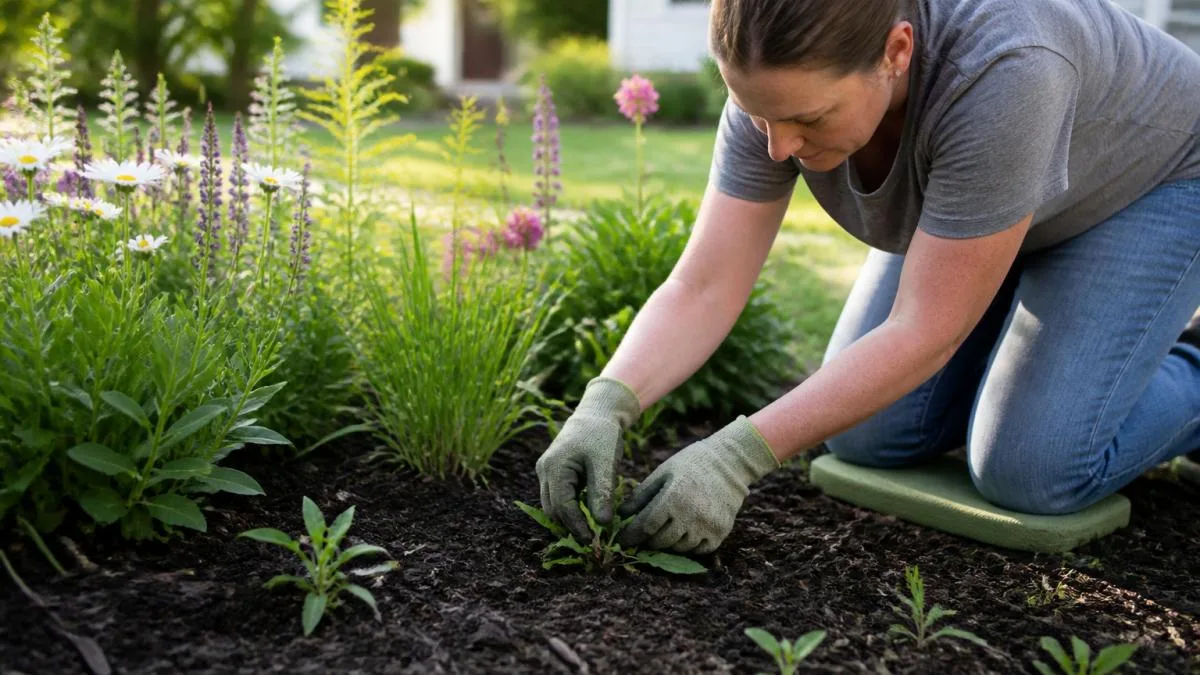
Follow this order:
- Water the bed the day before. Moist soil releases roots.
- Grip low. Pinch the weed at the soil line, not at the leaf tip.
- Pull with a slight twist. Steady pressure beats a hard yank.
- Support nearby flowers with your free hand so roots don’t shift.
- Shake off soil and drop weeds in your bucket.
For taproots, slide a weeding fork straight down beside the root and lever it loose. Pulling straight up snaps the root and it regrows in weeks.
A common mistake is pulling when the bed is bone dry. You’ll break roots and leave fragments behind.
Step 4: How to Kill Weeds Without Killing Flowers
Learning how to kill weeds without killing flowers comes down to targeting and timing. Most damage happens when spray drifts onto a desirable plant, when a non-selective product touches green stems, or when treatment is applied while pollinators are active.
Three application approaches work, and each has a place:
- Spot spraying. Use a shielded nozzle or a piece of cardboard as a barrier. Spray only the weed, and stop before the spray pattern reaches the drip line of nearby flowers.
- Wick or wipe application. Wipe herbicide onto weed leaves with a glove or sponge. Nothing drifts, which makes this the safest choice next to shallow-rooted annuals and bulbs.
- Cut-and-treat. Snip the weed stem and dab herbicide on the cut. Good for tough perennials with deep taproots, because the product moves down into the root instead of sitting on the soil surface.
Read the label before you open the bottle
The label is the legal directions for use, not a suggestion (the EPA). Check three things before mixing: the listed target weeds, the sites where the product is allowed, and the waiting period before replanting or seeding. A product labeled for lawns may not be labeled for beds containing ornamentals. Never mix two products unless the label explicitly allows it, and never store a diluted mix in an unmarked container.
Protect pollinators, pets, and people
- Spray in early morning or late evening when bees and other pollinators are not foraging. Avoid applying to anything in bloom, even weeds, because pollinators will visit weed flowers too.
- Check wind and weather. Skip application if wind is strong enough to move leaves, and do not spray if rain is expected within the label’s rainfast window.
- Keep pets and children off treated areas until the spray has dried and, for granular or long-residual products, for the interval stated on the label.
- Wear the protective equipment the label requires, at minimum gloves and eye protection for most homeowner products, plus long sleeves and pants.
Choose the right product for the bed
Non-selective products kill any green tissue they contact, so they belong on cut stumps, cracks, and bare soil, not on weed leaves surrounded by flowers. Selective broadleaf products are formulated to spare grasses, but they can still injure ornamental broadleaves, so confirm the label lists your plants or test on a small area first. For deeper guidance on caring for different garden plant types without damage, see our plant-specific guide.
Do not spray on a windy day. Mist travels farther than most people expect and can land on flowering plants, pollinators, and neighboring property. If you cannot control drift, switch to a wipe or cut-and-treat method.
Step 5: Does Mulch Prevent Weeds? Depth and Application Tips
Does mulch prevent weeds? Yes, when it is deep enough, applied at the right time, and kept away from plant crowns. Mulch blocks the light that weed seeds need to germinate, and a thick, uniform layer also makes the few weeds that do sprout easy to pull by hand.
How mulch actually stops weeds
Most weed seeds in a flower bed sit in the top inch of soil and need light to sprout. A 2- to 3-inch layer of mulch cuts off that light. It also moderates soil temperature and moisture, which keeps the bed easier to weed. The key is uniformity: a thin scatter leaves gaps where weeds push through, and a pile against a stem creates a different problem.
Depth by plant type and bed condition
- 2 to 3 inches of shredded bark, pine straw, or straw for most established beds.
- 1 to 2 inches around shallow-rooted perennials, annuals, and bulbs, where deep mulch can smother roots and hold moisture against tender growth.
- Keep mulch 2 inches back from stems, trunks, and the crowns of perennials. Mulch piled against a crown traps moisture and invites rot.
- On bare or newly cleared soil, a layer of cardboard or newspaper under the mulch adds a weed barrier that breaks down over the season. Wet the cardboard first, then cover it completely so it does not show and does not dry into a crust.
Timing and application
Refresh mulch in early spring before weed seeds germinate, and top-dress lightly in fall if the layer has thinned. Rake the old layer to break up matted areas before adding new material, because matted mulch sheds water instead of absorbing it. Water the bed after application to settle the mulch and knock dust off foliage.
Test depth with a finger or a marked stick. If you can push through the mulch and touch soil without much resistance, the layer is too thin to suppress weeds.
Too much mulch is as harmful as too little. Rake out cones and piles, especially around the base of shrubs and perennials, and never bury a plant crown to hide a bare spot. If weeds are already established, remove weeds before mulching so you are not covering live plants that will push back through.
Step 6: How to Prevent Weeds in Flower Beds Long Term
Prevention beats pulling every time. To prevent weeds in flower beds, crowd them out and cut off their seed supply.
Build these habits into your season:
- Plant densely. Ground cover and full perennials leave less bare soil.
- Remove seed heads before they open. One dropped seed head means dozens of new weeds.
- Edge the beds so grass runners don’t creep in.
- Check weekly for regrowth. Small weeds pull in seconds.
- Top-dress with compost to keep soil healthy and easy to work.
Keep your mowing height steady near bed edges. Short grass lets runners jump the border faster than tall grass does.
A low-maintenance bed is a planned bed. Group plants by water needs so bare patches don’t open up, and fill gaps with annuals while perennials establish.
When to Call a Professional for Bed Cleanup
Some beds are past the point where a weekend of pulling fixes them. Overgrown beds, deep-rooted weeds, and beds tangled with desirable plants take hours of careful work, and one wrong pull can cost you a plant you’ve grown for years.
Call a professional when:
- Weeds have taken over more than half the bed
- Roots run under established perennials
- You have physical limits on kneeling or lifting
- You’re prepping a property for sale and need curb appeal fast
That’s where we come in. Clean Cut Property Maintenance offers lawn care and full property maintenance, so the work gets done without you on your hands and knees. Our services include tree care, and you can contact our team for a custom quote.
Frequently Asked Questions
How do you remove weeds from a flower bed without damaging flowers?
Work by hand near your plants and pull weeds while the soil is moist, which lets roots slide out with less tugging. Hold the flower stems steady with one hand and pull the weed with the other so you do not uproot nearby plants. For weeds that grow right against a perennial, use a narrow weeding tool or a hand fork instead of a hoe. Water the bed the day before you weed to soften the soil and reduce the force needed.
Does mulch prevent weeds from growing in flower beds?
Mulch suppresses many weeds by blocking light that seeds need to sprout, but it does not stop all of them. Apply two to three inches of mulch and keep it a couple of inches away from plant stems and crowns to prevent rot. A layer that is too thin lets weeds push through, and mulch that is piled too deep can smother perennials. Refresh the layer each season and pull any weeds that emerge before they set seed heads.
When is the best time to pull weeds from a flower bed?
Pull weeds when they are young and the soil is moist, usually a day after watering or rain. Small weeds come out easily with the root intact, while older weeds with deep taproots break off and regrow. Remove weeds before they flower and drop seed heads, since one plant can spread thousands of seeds into the bed. A quick pass every week or two keeps the job small and protects your flowers from competition.
What is the safest way to remove weeds near flowers?
Hand pulling and targeted digging are the safest methods near desirable plants. If you use an herbicide, choose a non-glyphosate formula labeled for flower beds and apply it directly to the weed with a shielded sprayer or a brush, never a broadcast spray. Spray on a calm day when pollinators are not active, usually early morning or evening, and keep the product off flowers, soil around roots, and nearby foliage. Read the label for the required waiting period before replanting.
Weeding a flower bed by hand works until it doesn’t, and that’s usually the season your schedule fills up. Clean Cut Property Maintenance takes bed cleanup, lawn care, and plant care off your list with full-service landscape maintenance, specialized tree care, and a custom quote built around your property. Get started with Clean Cut Property Maintenance and get a yard that stays clean without lifting a finger.
