
Last Updated: November 4, 2026
Quick Summary
Effective lawn care for a small yard starts with a soil test, then choosing a grass type that matches your climate and sunlight. Mow weekly following the one-third rule, water deeply about 1 inch per week, and keep a simple seasonal schedule to avoid overwatering and overfertilizing.
- A soil test measures pH, nutrients, and soil type, and usually costs less than a bag of fertilizer.
- Most grass needs six hours of direct sun; choose shade-tolerant fine fescue for shady yards.
- Never cut more than one-third of the blade height at once to avoid shocking the grass.
- Water early in the morning, ideally before 10 a.m., to avoid disease and evaporation loss.
- Keep three or four tasks per season on your schedule, which is plenty for a small lawn.
Table of Contents
- Start with a Soil Test Before You Do Anything Else
- Pick the Right Grass Type for Your Small Yard
- Small Lawn Mowing Tips That Make a Big Difference
- Watering a Lawn in a Small Yard Without Waste
- Build a Simple DIY Lawn Care Schedule
- Lawn Care Mistakes to Avoid When Space Is Tight
- Get a Custom Quote for Your Small-Yard Lawn Care
- Frequently Asked Questions
Start with a Soil Test Before You Do Anything Else
Good lawn care starts below the surface. A soil test tells you what your grass is actually growing in, and it costs less than a bag of fertilizer.
Skip this step and you’re guessing. You might add lime your soil doesn’t need. You might feed a lawn that’s already rich in phosphorus. In a small yard, those mistakes are magnified because every square foot matters.
A basic soil test measures three things:
- Soil pH: how acidic or alkaline your soil is. Most lawn grasses prefer slightly acidic soil.
- Nutrients: nitrogen, phosphorus, and potassium levels.
- Soil type: whether you have heavy clay, sandy soil, or good loam.
Your local cooperative extension office usually offers low-cost soil testing, and the USDA Cooperative Extension System can point you to the right office. Dig a few small samples from different spots, mix them, and send them in.
Soil compaction matters too. In small yards, kids, pets, and foot traffic pack the ground down. Push a screwdriver into the soil. If it barely goes in, your soil is compacted and needs aeration.
Pick the Right Grass Type for Your Small Yard
The best grass for your small yard depends on your regional climate and how much sun the spot gets. Get this wrong and no amount of watering or feeding will fix it.
Grasses split into two families:
- Cool-season grass: fescue, Kentucky bluegrass, perennial ryegrass. These thrive in northern areas with cold winters and hot summers.
- Warm-season grass: Bermuda, zoysia, centipede, St. Augustine. These prefer southern heat and go dormant in cold weather.
Then check your light. Most grass needs six hours of direct sun. If your yard sits under trees or between buildings, choose a shade-tolerant variety like fine fescue.
Grass seed quality matters as much as the type. Buy fresh seed matched to your region, not a bargain bin blend. Cheap seed often carries weed seeds and low germination rates.
For small yards, seed is usually a better fit than sod. You can overseed thin spots yourself, and seed costs far less than rolls of turf.
Small Lawn Mowing Tips That Make a Big Difference
Mowing is the task you’ll repeat most, so get it right.
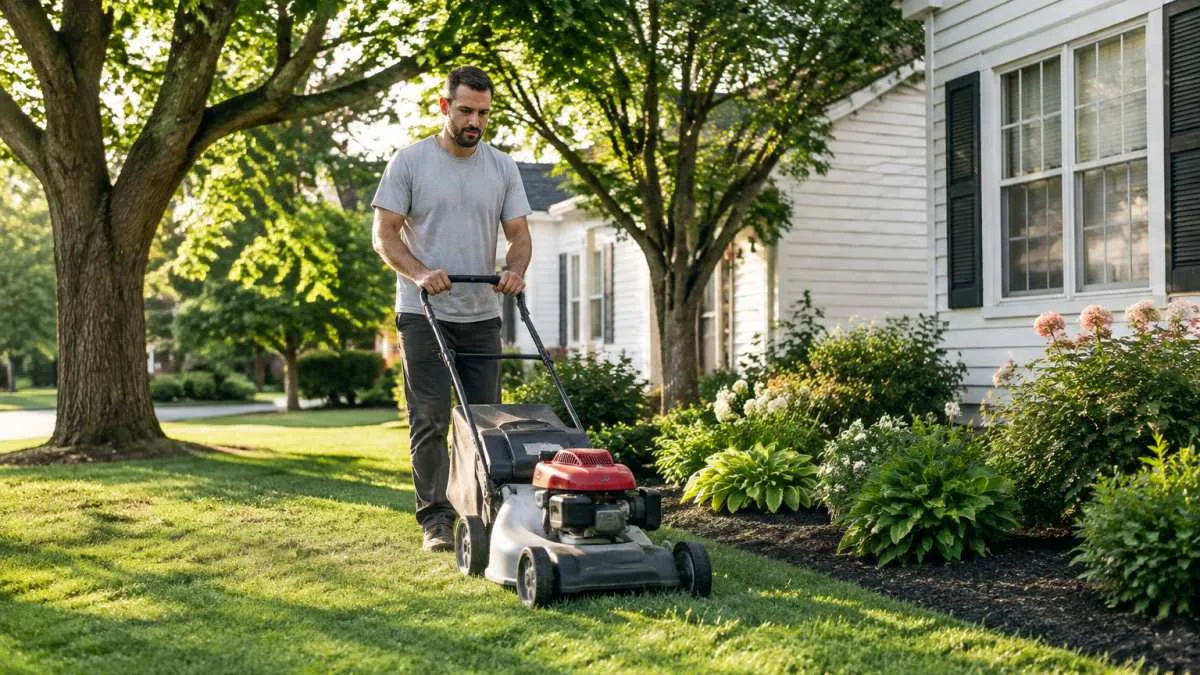
Follow the one-third rule: never cut more than one-third of the blade height at once. Cutting too short shocks the grass, weakens roots, and opens the canopy so sunlight reaches weed seeds.
Set your mower height by grass type. The table below uses inches, the unit most mower decks are marked in:
| Grass Type | Ideal Mowing Height |
|---|---|
| Fine fescue | 2-3 in |
| Kentucky bluegrass | 2.5-3.5 in |
| Bermuda | 1-1.5 in |
| St. Augustine | 3-4 in |
Mow weekly during the growing season.
Keep your mower blade sharp. A dull blade tears grass instead of slicing it, leaving ragged brown tips that invite disease.
Leave grass clippings on the lawn. They break down and return nitrogen and other nutrients to the soil for free.
For a small yard, equipment choice is where most beginners overspend or overbuy. A lightweight push mower or a cordless model is easier to store, turn, and maneuver around beds and fences than a ride-on, and it fits through narrow gates. Consider these small-yard trade-offs:
- Manual reel mower: quiet, no fuel or battery, easy to hang on a wall, but best on flat, even lawns and requires more frequent cutting.
- Cordless push mower: no cord to trip over, folds for storage, but battery runtime and replacement cost matter on larger lots.
- Corded electric mower: light and inexpensive, but the cord limits reach and is a hazard around trees and beds.
- String trimmer: essential for edges a mower can’t reach; use it before mowing so the mower can pick up the clippings.
Watch out: buying a wide-deck mower for a small, irregular yard can leave uncut strips along fences and beds, forcing more trimmer work than a narrower deck would.
Storage is part of the decision. Measure your shed or garage bay before you buy, and check whether the handle folds and whether the deck can be stored vertically.
Finally, change your mowing pattern.
Watering a Lawn in a Small Yard Without Waste
Deep watering beats daily sprinkling. Water less often but soak deeper, so roots grow down instead of staying near the surface.
The goal is about 1 in of water per week, including rain. Here’s how to check with a straight-sided can or a rain gauge:
- Set a small can on the lawn while you water.
- Time how long it takes to fill to 1 in.
- Water that long, once or twice a week, instead of a little every day.
Water early in the morning, ideally before 10 a.m. Evening watering leaves grass wet overnight, which invites disease. Midday watering loses a meaningful share to evaporation and wind.
Small yards have a big advantage here: a single hose-end sprinkler or a couple of spot sprinklers usually covers the whole lawn, so you don’t need an in-ground system. But small, narrow, and irregular spaces create their own watering problems. These are the ones most general guides skip:
- Runoff on slopes and clay. Water applied faster than the soil can absorb it runs off into the street or a neighbor’s yard. Cycle-and-soak watering fixes this: run the sprinkler for 10 to 15 minutes, let it soak in for 15 to 30 minutes, then repeat. Two or three short cycles put more water in the root zone than one long run.
- Overspray onto pavement. In a compact yard, a sprinkler pattern that’s slightly too wide waters the driveway and the sidewalk. Adjust the arc or use a sprinkler with adjustable coverage, and check the edges after the first minute.
- Hose-end timers. A battery-powered hose-end timer costs little and turns a manual chore into a consistent soak. Set it for early morning and use the cycle-and-soak pattern rather than one long run. Timers also help when you’re away, but check that the batteries are fresh before a trip.
- Targeted watering. For a single dry strip along a fence or under a tree, a watering wand or a soaker hose laid along the bed is more efficient than running the whole sprinkler. Soaker hoses deliver water slowly at the soil line, which reduces evaporation and overspray.
- Overwatering in narrow spaces. Small yards flood easily because there’s less area for water to spread. Soggy soil suffocates roots and grows fungus. If water stands for more than a few hours after watering, cut back the run time and improve drainage before adding more water.
Watch out: watering a small lawn on a fixed schedule regardless of rain is the most common way beginners overwater. Skip a cycle after a soaking rain, and use a rain gauge or the can test rather than guessing.
Watch for drought stress. Grass that’s thirsty turns bluish-gray and doesn’t spring back when you walk on it. If footprints stay visible, it’s time to water.
Make sure water actually soaks in. Runoff on a slope or compacted clay means you’re watering the sidewalk, not the roots.
Build a Simple DIY Lawn Care Schedule
A DIY lawn care schedule keeps you from forgetting tasks and helps you spot problems early. Here’s a simple plan you can adapt to your grass type.
| Season | Task |
|---|---|
| Early spring | Rake out debris, check for bare spots, sharpen mower blade |
| Late spring | Fertilize, spot-treat weeds, start weekly mowing |
| Summer | Water deeply, mow weekly, watch for pests and drought stress |
| Early fall | Overseed thin areas, aerate if compacted, fertilize cool-season grass |
| Late fall | Final mow, clear leaves, lime if your soil test says so |
You can model your own calendar on a seasonal lawn care schedule for the full year. If you’re setting up a feeding routine, this fertilization schedule for cool-season grass slots straight into the plan.
Keep the schedule short. Three or four tasks per season is plenty for a small lawn. Write it on a calendar and stick to it.
Lawn Care Mistakes to Avoid When Space Is Tight
The most common lawn care mistakes to avoid in a small yard all come from doing too much, too fast.
- Overwatering. Small yards flood easily. Soggy soil suffocates roots and grows fungus.
- Overfertilizing. More isn’t better. Too much nitrogen burns grass and feeds weeds.
- Cutting too short. Scalping weakens grass and lets sunlight reach weed seeds.
- Skipping thatch control. A thin layer of thatch is fine, but a thick mat blocks water and air. Dethatch when it builds up.
- Ignoring drainage. Low spots collect water and kill grass. Fix the grade before you reseed.
- Using the wrong weed killer. Some products harm your grass type. Read the label first.
One more: don’t fight shade with sun-loving grass. If an area stays thin no matter what, consider a groundcover or mulch bed instead of turf. That’s a low-input, low-cost choice many small-yard owners overlook.
Get a Custom Quote for Your Small-Yard Lawn Care
Small yards can be easy to manage, but they still need steady attention. If mowing, watering, and seasonal tasks keep sliding down your list, that’s when professional help pays off.
Clean Cut Property Maintenance handles lawn and plant care for homes and businesses, so you don’t have to lift a finger. Our team covers routine maintenance, tree care, and landscape work in one place, so you’re not juggling several contractors.
Want to see what’s included? Visit our lawn and plant care services page. Before you request a quote, it helps to know what residential lawn maintenance typically involves. And if you’re weighing the DIY route against hiring out, our guide on whether professional lawn service is worth it lays out the trade-offs.
Pricing depends on your yard size, the services you want, and how often you need us. Reach out for a custom quote and we’ll walk you through the options.
Frequently Asked Questions
What is the 1/3 rule for lawn care?
The 1/3 rule means you should never cut more than one-third of the grass blade height in a single mowing. For a lawn kept at 3 inches, mow when it reaches 4.5 inches. This keeps grass healthy, shades the soil, and reduces stress. It also helps prevent thatch buildup and makes mowing easier on small yards where a light cut takes just minutes.
How often should beginners mow a small lawn?
In spring and early summer, most small lawns need mowing every 5 to 7 days. In slower growth periods, every 10 to 14 days is fine. Follow the 1/3 rule rather than a strict calendar. Small lawns dry out faster, so avoid mowing during drought stress. Keep your mower blade sharp and vary the mowing direction each time to avoid ruts and lean.
How much should I water a small lawn?
Most lawns need about 1 inch of water per week, including rainfall. Water deeply once or twice a week rather than daily light sprinkling. For a small yard, a hose-end sprinkler with a timer works well. Water early in the morning to reduce evaporation. Check soil moisture by pushing a screwdriver into the ground; it should slide in easily after watering.
What lawn care mistakes should I avoid in a small yard?
Common mistakes include cutting grass too short, watering lightly and often, skipping a soil test, and using too much fertilizer. In small yards, overwatering and fertilizer runoff are bigger risks because there is less buffer. Avoid mowing with a dull blade and do not let weeds go to seed. Also, do not ignore shade and drainage issues, which are common in compact spaces.
A healthy small lawn comes down to a few simple habits: test your soil, pick the right grass, mow and water correctly, and stay ahead of problems. If you’d rather hand off the work, Clean Cut Property Maintenance offers full-service lawn and plant care, tree services, and landscape installation under one roof. Get started with Clean Cut Property Maintenance and enjoy a yard that looks cared for all season, without lifting a finger.
