
Last Updated: October 30, 2026
Quick Summary
You can remove tree roots without killing the tree by never removing more than 20% of the root system in a single year and cutting on only one side of the trunk per season. Safe tree root removal also means staying at least three times the trunk diameter away from the trunk and never cutting roots thicker than about 1 to 2 inches close to the trunk.
- Measure trunk diameter at chest height, about 4.5 feet above grade, before cutting any root.
- Roots over 3 inches across near the base are structural and can topple the tree if cut.
- Call 811 a few business days before digging to have buried utilities marked for free.
- Water deeply once a week during dry spells and keep mulch 2 to 4 inches deep, pulled back from the trunk.
- Give the tree a full year before any further root work and check the canopy each spring.
Table of Contents
- Can You Cut Tree Roots Without Killing the Tree?
- Living Tree vs. Removed Tree: A Decision Guide
- How Close to the Trunk Is Safe? Distance, Diameter, and Structural Roots
- Tree Root Removal Tools and How to Expose Roots Before Cutting
- How to Remove Tree and Stump Roots: Step-by-Step
- Tree Stump and Root Removal Cost: What Drives the Price
- Aftercare, Regrowth, and When to Stop and Call an Arborist
- Get a Custom Quote Before You Dig
- Frequently Asked Questions
Can You Cut Tree Roots Without Killing the Tree?
Yes, you can cut tree roots without killing the tree, but only within strict limits on how much root system you remove. A tree generally survives root cutting when the damage stays small and the cuts land far enough from the trunk.
Tree root removal is a balance between solving your problem and protecting the tree, which needs its roots for water, nutrients, and stability.
The Root-System Percentage Rule
The most useful guideline is the root-system percentage rule. Never remove more than 20% of a tree’s root system in a single year.
- One side only: Cut roots on just one side of the trunk per season.
- Small share: Keep removal well under a fifth of the total root mass.
- Recovery time: Give the tree a full year before further root work.
A common mistake is treating all roots as equal. The big structural roots holding the tree upright matter far more than the fine feeder roots you can barely see.
Living Tree vs. Removed Tree: A Decision Guide
The first question is simple: is the tree still standing? Root work on a living tree is delicate pruning; root removal after a tree comes down is a different task. The tools, risks, and rules are completely different.
Use this guide to pick your path:
| Situation | Goal | Approach | Risk Level |
|---|---|---|---|
| Living tree, root in the way | Protect the tree | Careful root pruning within limits | High if done wrong |
| Living tree, minor surface root | Clear a path or patio | Hand-cut small roots, monitor | Moderate |
| Tree already cut down | Remove stump and roots | Grind, dig, or pull the stump | Low for tree health |
| Dead or dying tree | Full removal | Stump grinder plus root extraction | Low, but utility risk |
For a standing tree, remove as little as possible. For a removed tree, get the stump and root ball out without hitting buried lines.
How Close to the Trunk Is Safe? Distance, Diameter, and Structural Roots
The safe distance depends on trunk diameter. A widely used rule of thumb is to stay at least three times the trunk diameter away from the trunk before cutting any root. Measure the trunk at chest height (about 4.5 feet above grade) and apply the multiplier.
Why the Rule Is Only a Starting Point
Root architecture varies enough that a single distance cannot cover every tree. Four factors move the real safe distance:
- Species: Shallow-rooted species concentrate structural roots near the surface and close to the trunk, so the margin you need is larger. Deep-rooted species give you more room, but the roots you hit may matter more to stability.
- Age and size: An old, established tree has a larger root system and less capacity to regrow lost roots. A young, vigorous tree rebounds from modest cutting. The same 30-inch cut is minor on a sapling and serious on a mature specimen.
- Soil: Loose, sandy, well-drained soil encourages wide spread and deeper anchoring. Compacted or shallow soil over rock or clay forces roots laterally near the surface, often closer to the trunk than the rule predicts.
Structural Roots Versus Feeder Roots
Not all roots carry the same job. Structural roots, the large woody roots that flare from the trunk and anchor the tree, are load-bearing. Feeder roots are the fine, fibrous roots that take up water and nutrients. The two respond very differently to cutting:
- Inside the safety zone: Do not cut large roots here; this is where structural roots anchor the tree.
- Root diameter matters: Never cut a root thicker than about 1 to 2 inches close to the trunk.
- Big roots are load-bearing: Roots over 3 inches across near the base are structural; cutting them can topple the tree.
Losing feeder roots is like pruning a hedge, the plant regrows. Losing a structural root is like removing a support cable, the load shifts to whatever is left.
How to Read the Root Before You Cut
Expose the root along its length before any blade touches it. Look for three signals:
- Diameter at the cut point. Under about 1 inch is low-risk; 1 to 2 inches is moderate; over 3 inches near the trunk is structural and needs an arborist’s assessment.
- Direction and attachment. A root running straight out from the trunk flare is likely structural; one that branches and weaves through topsoil is more likely a feeder.
- Depth. Structural roots usually sit within the top 12 to 18 inches of soil near the trunk. Deeper, farther roots are less likely to be anchors.
Cutting a large structural root close to the trunk can weaken the tree’s grip on the soil. A tree that leans after a storm is often one that lost an anchor root years earlier. If you expose a root over 3 inches across within the three-times-diameter zone, stop and get an arborist’s opinion before cutting.
When the Rule Doesn’t Fit
If any of these apply, assume the safe distance is larger than the rule suggests and get a professional assessment:
- The tree is mature, declining, or has visible decay at the base.
- The soil is shallow, compacted, or sits over rock or high clay content.
- The tree leans, has storm damage history, or grows on a slope.
The rule of thumb gets you a first answer; species, age, soil, and site get you the right one.
Tree Root Removal Tools and How to Expose Roots Before Cutting
You cannot cut what you cannot see, so exposing roots comes first.
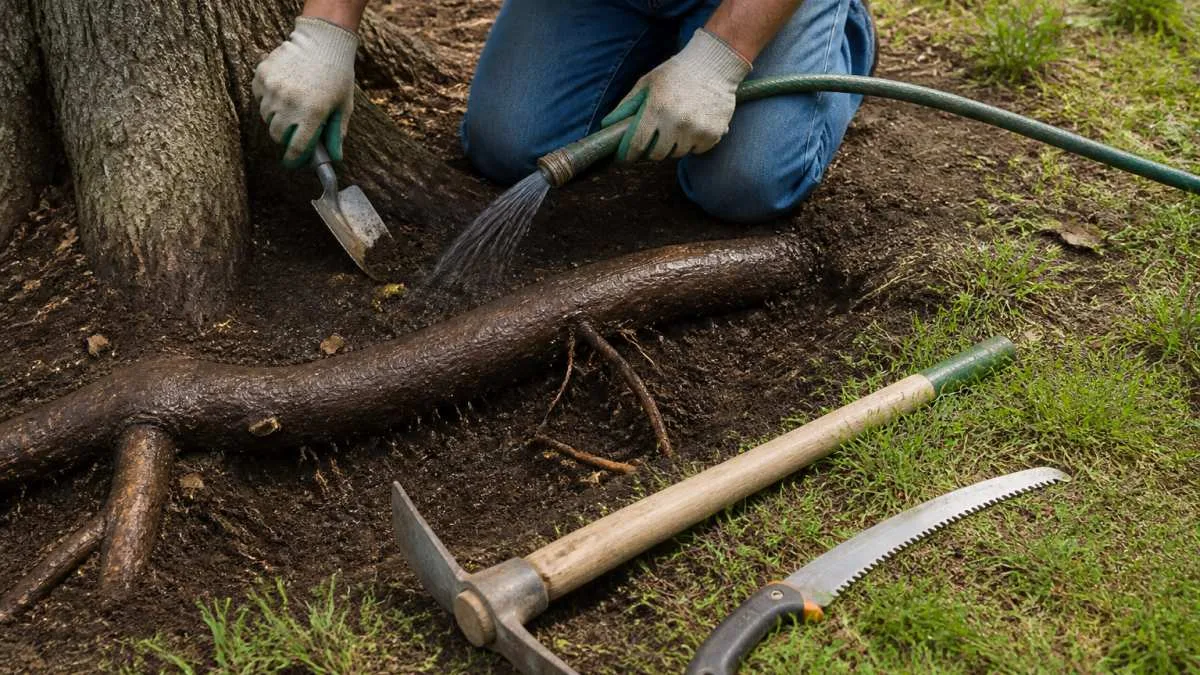
The right tool depends on root size, and using the wrong one damages the tree. A clean cut heals; a crushed or torn root invites rot.
Gather these tree root removal tools before you start:
- Hand trowel and digging fork: For loosening soil around small roots.
- Hose or gentle water spray: To wash soil away and reveal the root.
- Air spade: A professional tool that blasts soil away without cutting roots.
Expose the root along its length. Then decide: is it small enough to cut, or is it structural? When in doubt, stop and call a professional.
Utility-Location and Excavation Safety Steps
Before any digging, call 811, the national call-before-you-dig line, to have buried utilities marked (811 Before You Dig). This is free and required in most states. Cutting a gas, water, or electrical line is dangerous and expensive.
Follow these steps in order:
- Call 811 at least a few business days before you dig.
- Wait for utility crews to mark lines with flags or paint.
- Hand-dig near any marked line, never with power equipment. For site work and soil disturbance, see our grading service.
- Keep a safe margin around every marked utility.
- Stop immediately if you hit an unmarked line.
How to Remove Tree and Stump Roots: Step-by-Step
Removing roots from a tree that is already down is far simpler than pruning a living tree. The goal is to clear the stump and root ball so you can replant, pour a patio, or level the ground.
- Clear the area. Remove grass and debris around the stump.
- Expose the root flare. Dig down to find where the main roots spread from the stump.
- Cut the roots free. Use a saw or axe to sever roots around the stump base.
- Grind the stump. A stump grinder chews the stump below grade.
- Pull or dig the root ball. Use a mattock or machine to lift the remaining roots.
- Fill and compact. Backfill the hole with soil and tamp it down.
Watch out: a stump grinder throws debris. Wear eye and ear protection, and keep bystanders well back.
Tree Stump and Root Removal Cost: What Drives the Price
There is no single price for tree stump and root removal cost, because several factors move the number up or down. Pricing depends on the details of your job.
Here is what drives the price:
- Stump size and diameter: Bigger stumps take longer to grind.
- Root spread: Wide, shallow roots mean more digging and cutting.
- Access: A stump near a fence or house is harder to reach.
For a tailored number, request a custom quote so we can price your exact job. If the damage goes beyond the stump, learn about our yard restoration services for neglected properties.
Aftercare, Regrowth, and When to Stop and Call an Arborist
After root pruning, the tree needs help to recover, and damage often shows up a season later rather than the same week. That delay is why a monitoring timeline matters: most practitioners find the first 12 months after cutting decide whether the tree stabilizes or declines.
The First 12 Months: A Monitoring Timeline
Weeks 1-4: Stabilize. Water deeply during dry spells, a slow soak at the drip line once a week beats daily light sprinkling. Keep mulch 2 to 4 inches deep but pulled back a few inches from the trunk (Proper Mulching – Save plants, save money | Good Growing | Illinois Extension).
Months 2-6: Watch the canopy. This is when stress first shows. Look for yellowing leaves, premature leaf drop, or dieback at the branch tips. To keep the surrounding turf healthy through recovery, see our lawn care service.
Year 2 and beyond: Give the tree a full year before any further root work. Repeat the canopy and stability check each spring.
Preventing Regrowth
Cut roots and stumps often send up new shoots, especially on species that sprout readily from cut wood. The goal is to stop regrowth without harming the tree or the soil:
- Cut cleanly. A clean, angled cut heals better than a torn or crushed end and is less likely to rot.
- Remove the cut section. Leaving a severed root in the ground invites it to sprout; pull or dig out the section where practical.
- Do not paint cut ends with sealer. Most arborists advise against wound dressings on roots; they can trap moisture and encourage decay.
Recognizing Instability Before It Fails
A tree that lost an anchor root may stand fine for months and then fail in the first big storm. Check these signals after root work:
- New lean, or a lean that worsens after rain.
- Soil heaving or cracking on the side where roots were cut.
- Mushrooms or conks at the base, a sign of decay.
Root cutting damage is often delayed. Water and mulch for the first month, watch the canopy through month six, and check stability and regrowth by month twelve. If the tree leans, mushrooms appear at the base, or dieback spreads, stop and call an arborist before the next storm season.
When to Stop and Call an Arborist
Call a professional arborist if any of these apply:
- The tree starts to lean, or the lean worsens.
- Large branches die back on one side.
- Leaves yellow or drop out of season across a wide area.
If the job feels beyond a safe DIY effort, our tree care service can help. The safest path is to know your limits and get expert eyes on the tree before the damage shows up a season later.
Get a Custom Quote Before You Dig
Root work looks simple until you hit a structural root or a buried line. Know your limits and get expert eyes on the job before you start cutting.
Clean Cut Property Maintenance offers comprehensive residential and commercial services, expert tree and plant care, and a custom quote process built around your property. Reach out through our contact page to request pricing and book a visit.
Frequently Asked Questions
Does it hurt a tree to cut its roots?
Yes, cutting roots wounds the tree and removes some of its water and nutrient uptake capacity. The damage depends on how many roots you cut and how close to the trunk you cut them. Removing one or two small surface roots a few feet from the trunk usually causes minor stress. Cutting large structural roots within the trunk’s diameter can destabilize the tree and leave it vulnerable to windthrow and decay. Prune cleanly with a sharp saw rather than chopping or tearing, and avoid cutting more than a small share of the root system in one season.
How many roots can be cut without killing the tree?
A common guideline among arborists is to remove no more than about 20 to 25 percent of a tree’s root system at one time, and to avoid cutting structural roots within the trunk diameter. Cutting more than that, or cutting on more than one side of the trunk in the same year, raises the risk of decline. Young, healthy trees tolerate root pruning better than old or already stressed trees. If a project requires more than a modest cut, stage it over two or three seasons and monitor the canopy for dieback.
What tools are safest for removing small tree roots?
For roots under roughly 2 inches in diameter, a sharp pruning saw or loppers makes a clean cut. A mattock, pickaxe, or T-post digger helps loosen soil and lift roots without hacking at them. An air spade or a strong hose can expose roots with minimal damage to the ones you want to keep. Avoid chainsaws near soil, since grit dulls the chain fast and kickback risk rises. For anything larger, or any root within the trunk diameter, call a professional arborist before cutting.
How much does tree stump and root removal cost?
Pricing depends on stump diameter, root spread, access to the site, and whether the crew needs to grind below grade or hand-dig around utilities. Small stumps in open yards cost far less than large stumps near fences, foundations, or buried lines. Rather than quote a figure that may not fit your property, get a custom quote from a local tree care provider. Ask whether the price includes stump grinding, root removal, and debris hauling, since those are often billed separately.
