
Table of Contents
- Start With a Clear Scope of Work Before You Contact Anyone
- How to Check Landscaping Company Reviews the Right Way
- Licensing, Insurance, and Credentials That Actually Matter
- Questions to Ask a Landscaper Before You Sign Anything
- Your Landscaping Estimate Checklist: What Every Quote Should Include
- How to Compare Landscaping Quotes Without Getting Fooled
- Red Flags That Reliable Local Landscapers Never Show
- Conclusion: Making the Final Call on Your Landscaper
- Frequently Asked Questions
Last Updated: October 8, 2026
Start With a Clear Scope of Work Before You Contact Anyone
Finding reliable local landscapers starts long before you make a single phone call. It starts with a written scope of work.
A scope of work is a simple document that lists exactly what you want done, where, and how often. It turns a vague idea like “fix up my yard” into a clear job description that any company can bid on fairly.
Without one, you get quotes for different jobs. One company prices mowing only. Another prices full cleanup plus mowing. You can’t compare them, and the cheapest number usually means the least work.
Here’s what to write down before you contact anyone:
- Which areas need work: front lawn, back lawn, beds, trees, walkways
- What you want: mowing, trimming, cleanup, planting, tree care, pest control
- How often: weekly, biweekly, monthly, or one-time
- Any problem spots: drainage issues, overgrown sections, dead plants
- Your rough budget range and timeline for a decision
Spend 20 minutes on this step. It saves hours later.
How to Check Landscaping Company Reviews the Right Way
Reading reviews is not about star ratings. It’s about patterns.
How to check landscaping company reviews: look for repeated complaints across multiple reviews, not one angry post. A single bad review can happen to anyone. The same complaint five times is a warning.
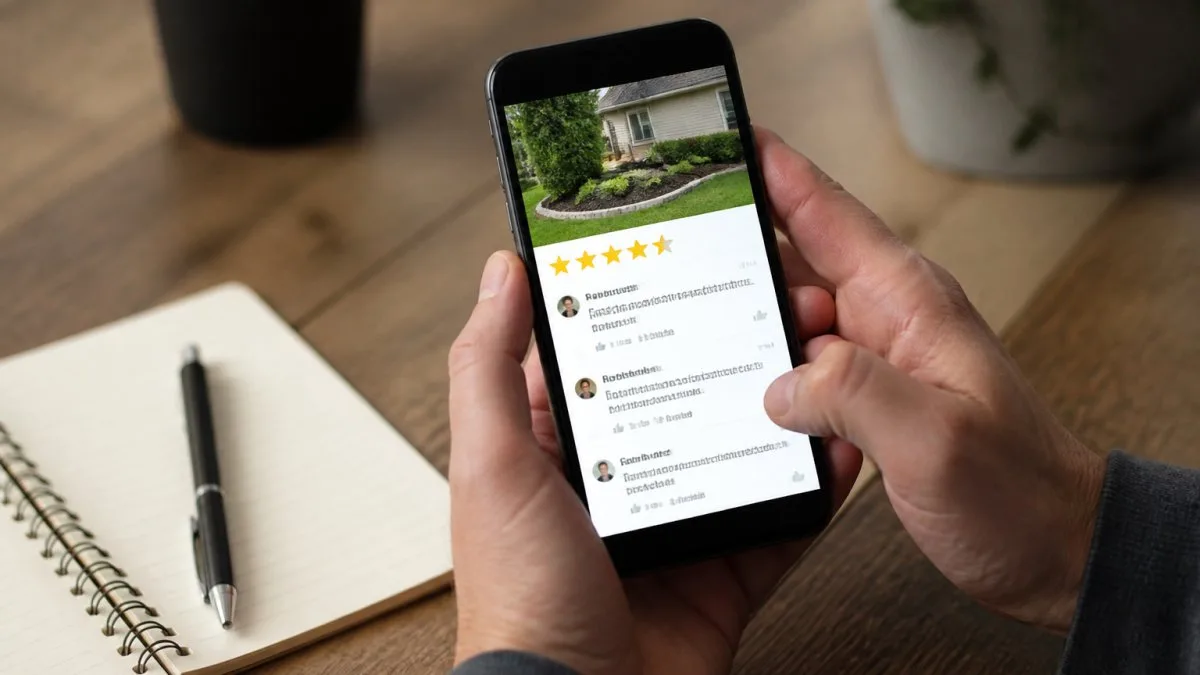
Here’s a smarter way to read them:
- Sort by newest first, not “most helpful”
- Read the 2-star and 3-star reviews, not just the 1-star and 5-star ones
- Look for words like “stopped showing up,” “no call back,” or “quality dropped”
- Check whether the owner replies to complaints, and how they reply
- Search the company name plus your town to catch reviews on other sites
A common mistake is trusting only the company’s own website testimonials. Those are hand-picked.
Check when the reviews were posted. A company with 40 reviews from three years ago and nothing since may have changed owners or stopped serving your area. Recent activity matters more than total volume.
Licensing, Insurance, and Credentials That Actually Matter
Ask for proof, not promises. Two documents matter most: a business license and liability insurance.
General liability insurance covers damage to your property. If a mower throws a rock through your window, this policy pays. Workers’ compensation covers injuries to crew members on your property. Without it, you could face a claim if someone gets hurt in your yard.
Many states also require specific licenses for certain work. Pesticide and fertilizer application usually needs a state-issued applicator license. Tree work near power lines often needs separate certification. Requirements vary by state, so check your state’s licensing board directly rather than trusting a verbal claim.
What to request before hiring:
- A copy of the business license
- A certificate of insurance with current dates
- The name of the insurance carrier, so you can call and confirm
- Any state pesticide or tree care credentials for specialized work
Reliable local landscapers hand these over without hesitation. If a company dodges the request, that tells you plenty.
Never accept a certificate of insurance without checking the expiration date. An expired policy is the same as no policy, and the cost of damage lands on you.
Questions to Ask a Landscaper Before You Sign Anything
The right questions separate a professional operation from a crew with a truck. Ask these during the estimate visit, in person.
Questions About Scope and Capability
- Can you handle everything, or will you subcontract parts of the job?
- Who is my main point of contact for questions?
- What happens if my regular crew is sick or on vacation?
- Do you have experience with the specific plants and trees on my property?
- Can you fix drainage problems, or only maintain what’s there?
That last one matters. Some companies only mow and trim. Others handle full yard restoration, debris removal, and overgrown cleanup. Know which type you’re hiring before you sign.
Questions About Reliability and Communication
- How far in advance do you schedule, and what happens if it rains?
- Will you notify me before each visit or send a service report after?
- What is your policy if I’m not happy with the work?
- Do you offer a written agreement, and what does it cover?
A company that answers these clearly is a company that shows up. Vague answers now mean vague service later.
Your Landscaping Estimate Checklist: What Every Quote Should Include
A landscaping estimate checklist keeps you from comparing incomplete quotes. Every written estimate should include these items:
- Full breakdown of services, itemized line by line
- Frequency and schedule for recurring work
- Total cost per visit and per month, with no hidden fees
- What is NOT included, such as mulch, plants, or disposal fees
- Start date and how long the first cleanup will take
- Payment terms and accepted payment methods
- Insurance and license confirmation
- A named contact and phone number
- Cancellation and satisfaction policy in writing
If a quote is a single number on a business card, ask for a full breakdown. A real company can produce one.
How to Compare Landscaping Quotes Without Getting Fooled
The lowest number is rarely the best deal. It usually means fewer services, less insurance, or a crew that disappears after two months.
How to compare landscaping quotes: put them side by side using the same scope of work, then compare what each one actually covers. Any quote missing items from your checklist is not cheaper. It’s incomplete.
| What to Compare | What to Look For | Why It Matters |
|---|---|---|
| Services listed | Matches your scope exactly | Missing items mean surprise costs later |
| Frequency | Weekly, biweekly, or monthly | Less frequent visits add up over a season |
| Insurance proof | Current dates on file | Protects you from damage claims |
| Contact person | A named individual | No name means no accountability |
| Satisfaction policy | Written, with a return visit | You get fixes, not excuses |
Get at least three quotes. Two is a coin flip. Three gives you a real picture of the market.
Also watch for quotes that are dramatically lower than the rest. A price far below everyone else often means the company plans to cut corners or raise rates after the first month.
Red Flags That Reliable Local Landscapers Never Show
Some warning signs show up before any work begins. Others appear in the first few weeks. Catch them early.
- Cash-only payment with no receipt. No paper trail means no proof of the agreement.
- Pressure to sign today. Real companies let you think it over.
- No physical address or business license. A truck and a phone number is not a business.
- Door-to-door sales after a storm. Storm chasers move town to town and vanish.
- No written estimate. Verbal deals fall apart the moment there’s a dispute.
- Different crew every visit with no explanation. Consistency is a sign of a stable operation.
- Rates that jump after month one. A low teaser price that climbs is a bait-and-switch.
One red flag might be a misunderstanding. Two or more means keep looking.
The strongest signal of a reliable company is simple: they answer their phone, show up when they say they will, and put everything in writing. Everything else is noise.
Conclusion: Making the Final Call on Your Landscaper
Hiring a landscaper comes down to trust backed by paperwork. You’ve done the hard part: a clear scope, real reviews, verified insurance, and side-by-side quotes.
If the process still feels like a second job, that’s where we come in. Clean Cut Property Maintenance handles full-service landscape design and installation, expert lawn and plant care, and specialized pest management and tree care for homes and businesses. One team covers everything, so you’re not juggling contractors. We also work with homeowners preparing to sell who need professional landscaping services to enhance curb appeal.
Get a custom quote from Clean Cut Property Maintenance and hand off the yard work for good.
Frequently Asked Questions
How many landscaping quotes should I get before hiring?
Get at least three quotes from different local landscapers. This gives you a clear picture of the going rate for your specific scope of work and helps you spot outliers. One quote might seem reasonable until you see two others that offer the same services for less, or with more detail in the estimate. Three also gives you enough variety to compare line items without getting overwhelmed by too many options.
What should a landscaping estimate include?
A thorough landscaping estimate should list every service line by line, including mowing, edging, trimming, debris removal, and any seasonal treatments. It should state the frequency of service, the total cost per visit or per month, and what happens if weather delays a scheduled visit. Ask whether the estimate covers disposal fees, fuel surcharges, or any other add-ons. If the quote is a single lump sum with no breakdown, ask for more detail before you compare it to others.
Should a landscaper be licensed and insured?
Yes. Ask for a copy of their general liability insurance and workers’ compensation coverage before any work begins. If a crew member gets injured on your property or a mower damages your fence, you want to know the company’s insurance will cover it, not your homeowner’s policy. Licensing requirements vary by state and municipality, so ask the company directly what credentials they hold and verify them with your local licensing board if needed.
What are the biggest red flags when hiring local landscapers?
Watch for companies that demand full payment upfront, give you a quote over the phone without seeing your property, or can’t provide proof of insurance. Other warning signs include no written contract, vague estimates that don’t list what’s included, and high crew turnover that means you never see the same faces twice. If a company pressures you to sign on the spot or won’t answer basic questions about their process, walk away and keep looking.