
Table of Contents
- What Expert Landscape Design for Small Yards Actually Involves
- Small Yard Landscaping Ideas That Maximize Every Square Foot
- Small Garden Layout Ideas for Tight Spaces
- Small Yard Design With Plants and Hardscaping
- Low-Maintenance Landscaping for Small Yards
- What Landscape Design for Small Yards Costs and What Drives the Price
- DIY vs Hiring a Landscape Designer: What Works for Small Yards
- Frequently Asked Questions
Last Updated: October 13, 2026
What Expert Landscape Design for Small Yards Actually Involves
Expert landscape design for small yards is the practice of planning every square foot of a compact outdoor space around how you actually live in it, rather than around a catalog of features that won’t fit.
That distinction matters more than most homeowners expect.
This guide covers the layouts, plant choices, cost drivers, and hiring decisions that separate a yard that works from one that just looks busy.
Small-yard design is a subtraction exercise, not an addition exercise. Decide what earns its footprint before you decide what looks good.
Why Lot Size and House Placement Drive Every Decision
Every small-yard plan starts with two fixed constraints: the dimensions of the lot and where the house sits on it.
A house pushed toward the front of the lot leaves a deep backyard but a shallow front yard. A house centered on the lot splits the space evenly, which usually means neither side is generous.
Three measurements do most of the work:
- Usable depth: the distance from the back wall of the house to the rear fence line
- Side clearances: the narrowest gap between the house and the property line
- Sun path: which areas get six or more hours of direct light, and which sit in shade most of the day
Get these wrong and the rest of the plan fights itself. Get them right and the layout almost suggests itself.
Skipping a basic site assessment is the most expensive mistake in small-yard work. A patio poured over a low spot that collects water will crack or heave within a few seasons, and fixing drainage after installation costs far more than grading it correctly beforehand.
Small Yard Landscaping Ideas That Maximize Every Square Foot
The best small-yard landscaping ideas share one trait: each element does at least two jobs.
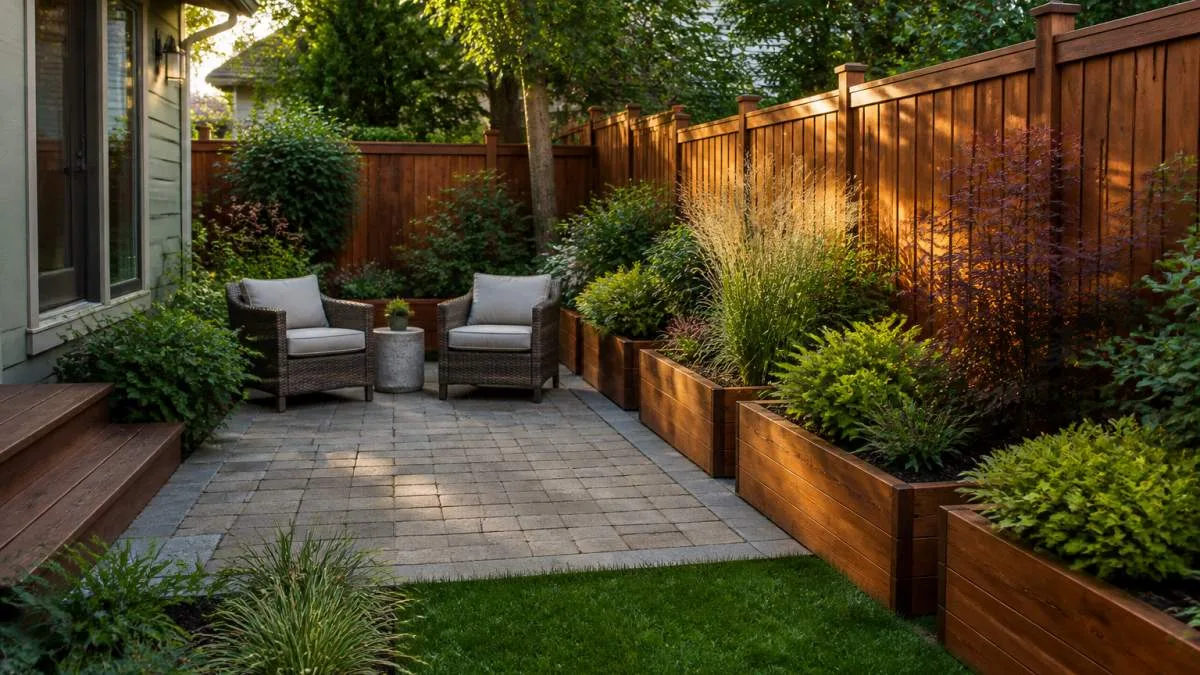
A raised planter along a fence line grows vegetables, screens an ugly boundary, and adds height that makes the yard feel deeper.
Here’s how we’d prioritize the elements in a typical small yard:
| Element | Typical Footprint | Primary Job | Secondary Benefit |
|---|---|---|---|
| Paver patio | 9-14 sq m | Outdoor seating | Defines the room |
| Raised planters | 1-2 sq m each | Growing space | Fence screening |
| Vertical trellis | Under 1 sq m | Climbing plants | Privacy, height |
| Gravel or stone path | 1-1.5 m wide | Circulation | Drainage |
| Container grouping | 0.5-1 sq m | Color and interest | Movable accent |
The order matters. Patios and paths come first because they’re the hardest to move later. Planters and containers fill what’s left. If you start with plants, you end up redesigning around them.
How to Divide a Small Yard Into Functional Areas
Dividing a small yard works best with soft boundaries: a change in ground material, a low planter, or a slight grade shift rather than a wall or fence.
A yard that’s one undifferentiated rectangle reads as smaller than it is. Break it into two or three zones and the same space feels larger and gets used more.
Keep transitions subtle. A 10 cm grade change, a strip of gravel between two paver fields, or a row of low ornamental grasses all signal “different area” without eating floor space the way a hedge or partition would.
Run your main pathway along one edge rather than down the middle. A central path cuts the yard into two unusable halves; an edge path leaves one continuous open area that photographs and functions better.
Small Garden Layout Ideas for Tight Spaces
Small garden layout ideas succeed when they follow the same planning logic as the rest of the yard, with one addition: plant in layers.
Layering means stacking plants by height so the eye travels from ground cover up through mid-height perennials to a taller backdrop. In a narrow bed, that might be creeping thyme at the front, coneflower or salvia in the middle, and a small ornamental tree or tall grass at the back. Three layers in a 60 cm deep bed do more visual work than a single row of shrubs in a bed twice as wide.
A few layout principles that hold up across most tight spaces:
- Repeat two or three plant varieties rather than collecting many, because repetition reads as intentional design
- Group containers in odd numbers and vary their heights
- Leave one area deliberately open, since a small yard with no breathing room feels cramped
- Match bed depth to plant mature size, not nursery-pot size
Small Yard Design With Plants and Hardscaping
Small yard design with plants and hardscaping is a balancing act: hardscape provides structure and usable surface, softscape softens it and adds seasonal change. Too much of either and the space fails.
Hardscape covers the built elements: patios, pathways, retaining walls, edging, and gravel. Softscape covers everything living: trees, shrubs, perennials, ground cover, and lawn. In a small yard, hardscape typically takes up the majority of the ground plane because you need somewhere to stand, sit, and walk. That makes the softscape that remains disproportionately important, since it carries nearly all the color and texture.
Plant Selection for Small Spaces
Plant selection for small spaces should favor slow-growing, well-behaved varieties over anything that spreads aggressively or outgrows its spot within a few seasons.
The plants that cause the most trouble in compact yards are the ones sold as fast growers. They fill a bed in two years and overrun it in five, and by then they’re expensive to remove. Native and drought-tolerant species are usually the safer bet: they’re adapted to local rainfall and soil, they need less irrigation once established, and they support pollinators.
Five categories worth building a small-yard planting plan around:
- Ornamental grasses for movement, height, and winter structure
- Compact evergreens for year-round screening without a hedge’s bulk
- Native perennials for low water needs and pollinator value
- Dwarf shrubs for mid-height mass that stays in bounds
- Ground covers to fill bare soil and cut weeding
Homeowners who want a planted yard but travel often or dislike regular watering. Native and drought-tolerant selections tolerate missed irrigation far better than bedding annuals.
Low-Maintenance Landscaping for Small Yards
Low-maintenance landscaping for small yards means designing out the tasks you dislike, not just planting tougher plants.
The recurring chores in a small yard come from a short list: mowing, weeding, watering, pruning, and leaf cleanup. You can reduce each one at the design stage. Replace lawn with ground cover or mulch and mowing disappears.
A practical sequence for cutting maintenance:
- Reduce lawn area to only what you actually use
- Install drip irrigation with a timer on all planting beds
- Apply 5-8 cm of mulch to suppress weeds and hold moisture
- Choose slow-growing, compact varieties so plants don’t outgrow their space
- Sweep instead of blowing where surfaces allow, which is faster and quieter
Drainage belongs in this conversation too. A small yard has less area to absorb runoff, so grading that directs water away from the foundation and toward a planted or gravel area prevents both foundation problems and the muddy patches that make a yard feel neglected.
What Landscape Design for Small Yards Costs and What Drives the Price
Pricing for landscape design and installation depends on scope, site conditions, and materials, and it varies enough between projects that any single number would mislead you. What we can tell you is what moves the price up or down.
The biggest cost drivers in a small-yard project:
- Site preparation: removing old concrete, correcting grading, or fixing drainage adds significant labor before any new work begins
- Hardscape materials: natural stone costs more than manufactured pavers, which cost more than gravel
- Access: a backyard reachable only through a narrow side gate slows every delivery and raises labor time
- Plant size: larger, more established plants cost more up front but establish faster
- Irrigation: adding a drip system and timer is an added line item, not a default
- Scope of design work: a full plan with plant schedules and construction details takes more time than a verbal walkthrough
For current pricing on design and installation, request a custom quote rather than relying on a generic estimate. A quote built from your actual dimensions and site conditions will be far more accurate than any published range.
The cheapest quote is often the one that skips site preparation, drainage correction, and soil amendment. Those costs reappear later as settling patios, dead plants, and standing water, usually at a higher total.
DIY vs Hiring a Landscape Designer: What Works for Small Yards
Hiring a landscape designer makes sense when your project involves grading, drainage, hardscape construction, or irrigation. Doing it yourself works when you’re refreshing planting beds, adding containers, and improving mulch and soil.
The dividing line is whether the work touches water, structure, or utilities. Planting is forgiving; you can move a shrub.
A simple way to decide:
| Your Situation | Best Approach | Why |
|---|---|---|
| Refreshing beds, adding containers | DIY | Low risk, reversible, low cost |
| New patio or pathway | Hire a professional | Base prep and grading decide longevity |
| Standing water or drainage issues | Hire a professional | Requires grading and possibly French drains |
| Full yard redesign from bare ground | Hire a professional | Sequencing and site assessment matter |
| Overgrown cleanup before a sale | Hire a professional | Volume of debris and disposal |
One more consideration: coordination.
If you’re preparing a property for sale, curb appeal work is time-sensitive, and having one team handle cleanup, planting, and installation on a schedule keeps the project on track.
A small yard doesn’t limit what you can do with it. If you’d rather hand the whole thing off than spend a season measuring sun angles and hauling pavers, Clean Cut Property Maintenance offers full-service landscape design and installation, ongoing lawn and plant care, and specialized pest services, all through a single custom quote.
Frequently Asked Questions
How do you design a landscape for a small yard?
Start with a site assessment: measure your lot, note sun and shade patterns, and identify drainage issues. Then plan zones for seating, planting, and pathways before choosing materials. A landscape designer can translate those measurements into a scaled landscape plan, which prevents costly mistakes like oversized patios or plants that outgrow their space. Professional landscape design for small yards focuses on proportion, sight lines, and multi-use elements so every square foot works harder.
How can you make a small yard look bigger?
Use diagonal pathways to draw the eye across the space, keep hardscape materials consistent to avoid visual breaks, and layer plants by height so the garden reads as deeper than it is. Vertical gardening on fences and walls adds greenery without consuming ground area. A landscape designer can also use grading and low privacy screening to create the illusion of extended space. These techniques appear in most small garden layout ideas because they cost little but change how the yard feels.
What plants work best in a small yard?
Compact native plants and drought-tolerant plants perform well because they need less water and upkeep once established. Columnar shrubs, ornamental grasses, and dwarf varieties give you visual interest without overtaking the space. Container planting lets you move color where you need it. A professional landscape installation team can match plants to your shade conditions, soil, and hardscape so the planting plan stays healthy year after year instead of needing constant replacement.
How much does it cost to landscape a small yard?
Pricing depends on project scope, materials, plant quantities, and site conditions like grading or drainage work. A simple refresh with new plantings and mulch costs far less than a full design-build with a patio and irrigation. Because every yard differs, the most accurate approach is a design consultation and a custom quote. Clean Cut Property Maintenance provides tailored quotes so you know the cost before work begins, with no surprises mid-project.
Can a professional landscape designer help with a small yard?
Yes. Small yards are actually where design expertise matters most, because mistakes are more visible and harder to hide. A landscape architect or designer brings space planning skills, knowledge of local plant performance, and contractor relationships that keep the project on schedule. They also handle grading and drainage so water flows away from your foundation. For low-maintenance landscaping for small yards, that upfront planning reduces long-term upkeep significantly.
What are low-maintenance landscaping ideas for small yards?
Choose drought-tolerant plants and native plants that thrive in your climate, install drip irrigation instead of spray heads, and use hardscape like patios and pathways to reduce lawn area. Mulch beds heavily to suppress weeds. These choices cut weekly chores while keeping the yard looking intentional. Many homeowners pair this approach with a maintenance plan so pruning, pest management, and seasonal cleanups are handled without adding tasks to their own schedule.