
Table of Contents
- How to Identify Lawn Insect Damage Before It Spreads
- Lawn Pest Prevention Tips That Actually Work
- Integrated Pest Management for Lawns: A Step-by-Step Approach
- Safe Lawn Insect Control for Pollinators, Pets, and Children
- Seasonal Pest Calendar: When to Watch for Lawn Pests
- Recovery and Prevention After a Lawn Pest Infestation
- Frequently Asked Questions
Last Updated: October 6, 2026
How to Identify Lawn Insect Damage Before It Spreads
Preventing lawn damage from common pests starts with knowing what you are looking at. Most homeowners spot the problem weeks late, a brown patch that looked like drought stress turns out to be a grub infestation that has already eaten through the root zone.
The difference between pest damage and disease or drought comes down to pattern and timing. Learn to read the lawn before you buy anything.
Damage Patterns That Point to Specific Pests
Different pests leave different signatures. Match the pattern to the likely culprit:
- Spongy, loose turf that peels back like carpet: white grubs feeding on roots below the surface
- Irregular brown patches spreading fast in summer: armyworms or sod webworms chewing blades at night
- Spongy mounds and tunnels near the surface: mole crickets loosening the soil
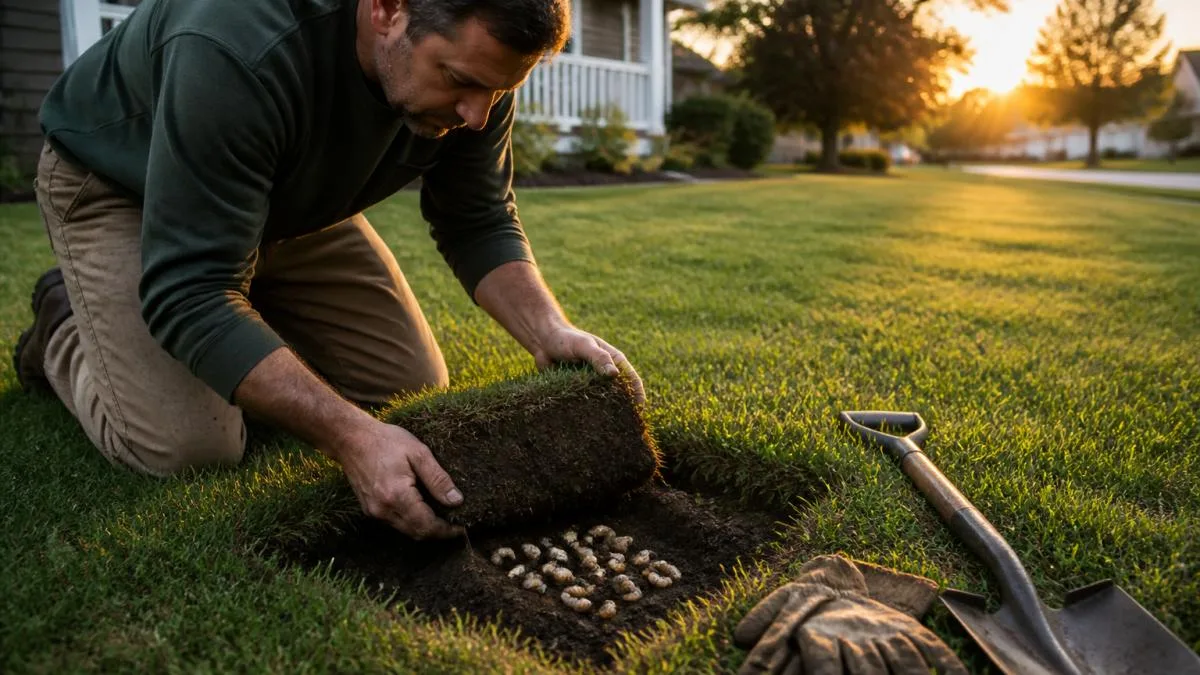
A simple test: cut a 30 cm square of turf, lift it, and count the larvae beneath. Two or three grubs is tolerable; ten or more means it is time to act.
Check your lawn at night with a flashlight. Armyworms and sod webworms feed after dark, so you will spot them on the blades when daytime inspections turn up nothing.
Lawn Pest Prevention Tips That Actually Work
The best pest control is a lawn that pests struggle to invade. Healthy turfgrass grows through mild damage and recovers faster. Weak, stressed grass does the opposite.
Mowing Height, Watering, and Fertilization Basics
Get these three right and you remove the conditions pests prefer:
- Mow high. Keep cool-season grasses at 7.5 to 9 cm and warm-season grasses at 5 to 7.5 cm. Taller blades shade the soil, crowd out weeds, and hide tender crowns from surface feeders.
- Water deeply, not often. One or two long soakings per week beat daily light sprinkling. Deep watering pushes roots down. Overwatering does the reverse and invites grubs and disease.
- Fertilize for the species. Feed cool-season lawns mainly in fall and warm-season lawns in late spring and summer. Match the product to your grass species and soil test results.
Remove leaf litter, debris, and thatch so pests lose hiding spots, and never cut more than one-third of the blade height at once.
USDA turfgrass and soil health resources
Integrated Pest Management for Lawns: A Step-by-Step Approach
Integrated pest management, or IPM, combines monitoring, cultural practices, and targeted treatment instead of blanket spraying. You only treat when sampling shows the pest population has crossed a threshold that justifies the cost and risk.
Step 1: Monitor With a Repeatable Method
Eyeballing the lawn is not monitoring. Use the same sampling method each week so results are comparable.
- Grubs and soil-dwelling larvae: Cut a 1-square-foot plug of turf about 2 to 3 inches deep at three or four spots per zone, lift it, and count the larvae in the soil and thatch beneath. Replace the plug and water it in.
- Surface feeders (armyworms, sod webworms, chinch bugs): Do a flotation test. Push a bottomless coffee can or a 6-inch section of metal pipe into the turf, fill it with water, and watch for 5 to 10 minutes. Caterpillars and chinch bugs float to the surface.
- Night feeders: Walk the lawn at dusk with a flashlight and a white sheet. Armyworms and sod webworms feed after dark and drop off blades when disturbed.
Record the date, location, pest count, and turf condition, a phone note is enough. Patterns emerge after three or four weeks that one inspection will miss.
Step 2: Identify Before You Treat
Wrong identification means the wrong product, the wrong rate, and wasted money. Confirm the species with a hand lens or photo and cross-check your state extension service’s turf insect guide. Grubs, billbugs, chinch bugs, sod webworms, armyworms, and mole crickets all produce different damage signatures and require different active ingredients.
Step 3: Set a Treatment Threshold
A threshold is the pest count at which treatment costs less than the damage the pest will cause. Thresholds vary by grass species, turf use, and season, but common working numbers include:
- White grubs: 5 to 10 grubs per square foot on healthy, irrigated turf; lower (around 3 to 5) on stressed or newly established lawns.
- Chinch bugs: 15 to 20 nymphs or adults per square foot in a flotation sample.
- Sod webworms and armyworms: 10 to 15 larvae per square yard, or visible thinning that is spreading daily.
Below threshold, cultural fixes and beneficial insects usually keep populations in check; above threshold, targeted treatment is justified.
Step 4: Fix Cultural Conditions First
Most infestations take hold because the lawn was already stressed. Before any product goes down, correct mowing height, watering depth and frequency, soil pH, thatch thickness, and compaction. A soil test every two to three years tells you what the grass needs.
Step 5: Choose the Least Disruptive Control That Works
Work down this ladder:
- Biological controls, beneficial nematodes for grubs, Bacillus thuringiensis (Bt) varieties for caterpillar larvae, and milky spore where it is effective for Japanese beetle grubs.
- Targeted insecticides, spot-treat only the affected zone with a product labeled for the identified pest, at the label rate and timing.
- Broad-spectrum sprays, last resort, because they kill pollinators and beneficial predators that suppress the next outbreak.
Step 6: Treat at the Right Life Stage
Timing matters more than product choice for many pests. Grub treatments work best when larvae are small and near the surface, typically late summer to early fall. Chinch bug and billbug treatments are most effective on young nymphs in late spring and early summer; treating adults at the wrong time wastes the application.
Step 7: Recheck and Record
Re-sample two to three weeks after treatment using the same method. If counts have not dropped, the product, rate, timing, or identification was wrong. Record what worked so next season’s plan starts from evidence.
| Step | Action | Method | When |
|---|---|---|---|
| Monitor | Count pests | 1 sq ft plug or flotation test | Weekly in peak season |
| Identify | Confirm species | Hand lens, extension guide | Before any treatment |
| Threshold | Compare to count limit | Grubs 5-10/sq ft; chinch bugs 15-20/sq ft | After ID |
| Cultural fix | Mow, water, soil test | Ongoing practices | Continuous |
| Targeted control | Spot-treat | Label rate, right life stage | Per pest calendar |
| Recheck | Re-sample | Same method as before | 2-3 weeks post-treatment |
Treatment thresholds matter more than products. Most lawns recover from light pest pressure without any chemical treatment if the grass is otherwise healthy, but only if you sample instead of guessing.
Safe Lawn Insect Control for Pollinators, Pets, and Children
Chemical treatment carries real trade-offs. Broad-spectrum insecticides kill pests and beneficial insects, including pollinators, and can linger on turf where pets and children play.
Safer approaches to keep in mind:
- Apply products in the evening when pollinators are not active
- Avoid spraying blooming clover or flowering weeds
- Keep pets and children off treated areas until the label says it is safe
Always follow the product label, the legal and safety standard that gives the correct rate, timing, and re-entry period.
EPA guidance on pesticide safety and pollinator protection
Never apply an insecticide to a lawn in bloom. You will kill the bees and butterflies feeding there, and you may need to reseed pollinator-friendly plants later.
Seasonal Pest Calendar: When to Watch for Lawn Pests
Timing decides whether treatment works. Pests have predictable windows tied to soil temperature, day length, and moisture, and hitting the wrong window wastes money. This calendar uses triggers you can measure, so you can shift it to your climate.
How to Read This Calendar
Soil temperature at 2 inches deep is the most reliable trigger for insect activity, and a cheap soil thermometer is enough. Cool-season grasses support pest activity at lower soil temperatures than warm-season grasses, so adjust the months below by two to four weeks for your region and grass type.
Early Spring (Soil 50-55°F)
- What is active: Overwintering white grubs resume feeding as soil warms. Adult billbugs start moving into turf. Skunks, raccoons, and birds dig for grubs at night.
- What to do: Pull a 1-square-foot plug in several zones and count grubs. If you see animal digging, that is a signal grub numbers are high enough to attract predators. Hold off on preventative grub treatments, most are timed for late summer.
Late Spring to Early Summer (Soil 65-70°F)
- What is active: Chinch bugs hatch and begin feeding in warm-season lawns. Mole cricket nymphs emerge. Billbug larvae start tunneling in stems.
- What to do: Run a flotation test in sunny, stressed patches. Watch for yellowing that spreads from the center of the lawn outward, a classic chinch bug pattern. This is the best window for chinch bug and billbug treatment if counts cross threshold.
Midsummer (Soil 75-85°F)
- What is active: Armyworms and sod webworms cause fast, patchy damage, often after heavy rain or a wet stretch. Chinch bug damage peaks in drought-stressed turf.
- What to do: Inspect at dusk with a flashlight. Look for chewed blade tips and green frass pellets. Treat caterpillars when larvae are small, Bt products work best at this stage.
Late Summer to Early Fall (Soil 70-75°F)
- What is active: This is peak grub season for many species. New larvae hatch and feed hard before winter. Japanese beetle, masked chafer, and May/June beetle grubs are all active.
- What to do: This is the primary window for preventative grub treatments, because larvae are small and close to the surface. Sample before treating, do not treat on calendar alone.
Fall (Soil 55-60°F)
- What is active: Grubs continue feeding until soil cools. Adult beetles are done for the season.
- What to do: Overseed damaged zones and correct soil issues. Fall is also a good time for a soil test so spring fertilization is based on data.
Winter (Soil Below 50°F)
- What is active: Most pests are dormant or in overwintering stages. Grubs move deeper in the soil profile.
- What to do: Plan next season. Review your monitoring notes, order beneficial nematodes for spring, and schedule any preventative treatments for the correct window.
Adjusting for Your Climate
A warm, wet spring brings pests out earlier; a cool, dry spring delays them. Coastal and southern regions often run two to four weeks ahead of this calendar, northern regions two to four weeks behind. Your state extension service publishes regional pest emergence maps and growing degree day (GDD) models for many turf pests, use those to fine-tune the months above.
Track soil temperature at 2 inches deep each morning for a week. When it holds above the trigger for your target pest for several consecutive days, start monitoring that pest weekly.
Recovery and Prevention After a Lawn Pest Infestation
Once the pests are gone, the lawn needs help to come back. Recovery is as much about prevention as repair.
Remove dead debris and rake out the damaged zone. Aerate to relieve compaction, then overseed with a grass species suited to your climate and light.
The goal is a pest-resistant lawn: thick, well-fed, and properly watered so the next infestation has no room to take hold.
university extension guidance on lawn pest recovery
Most homeowners can handle light pest pressure with better mowing, watering, and soil care. Clean Cut Property Maintenance handles full-service lawn and plant care, specialized pest management, and tree care, so you are not juggling three contractors for one yard.
Frequently Asked Questions
What types of bugs can damage grass?
The most common lawn pests in the U.S. include grubs (Japanese beetle and June bug larvae), armyworms, mole crickets, chinch bugs, and sod webworms. Grubs feed on roots underground, causing spongy turf that lifts easily. Armyworms and sod webworms chew grass blades, leaving ragged edges and bare spots. Mole crickets tunnel near the surface, loosening soil and uprooting grass. Chinch bugs inject toxins while feeding, creating yellow then brown patches in sunny areas. Identifying the pest correctly determines the right treatment timing and product.
How can you tell whether lawn damage is caused by pests?
Pest damage often appears as irregular brown or yellow patches that spread outward, unlike drought stress which tends to affect the whole lawn evenly. Pull on a patch of grass: if it lifts like a carpet, grubs have likely eaten the roots. Look for spongy spots, birds or raccoons digging at night, or moths flying up as you walk. A simple drench test (mixing a tablespoon of dish soap in a gallon of water and pouring it over one square foot) can flush hidden insects to the surface for identification.
When should you treat a lawn for insect pests?
Timing depends on the pest. For grubs, treat in late summer or early fall when larvae are small and actively feeding near the surface. Armyworms and sod webworms are best treated when you first notice moths or chewing damage in late spring through summer. Chinch bugs need treatment when daytime temperatures consistently exceed 80°F and you spot yellowing in sunny spots. Always confirm an active infestation before applying any product, and follow label timing to protect pollinators.
What lawn care practices help prevent pest damage?
Core practices include mowing at the proper height for your grass species (usually 3 to 4 inches for cool-season grasses), watering deeply once or twice a week instead of daily light sprinkling, and fertilizing based on a soil test rather than a calendar. Aerating compacted soil and removing thatch thicker than half an inch reduces pest habitat. Clearing leaf litter and debris from the lawn surface eliminates hiding spots. These cultural steps build denser turf that tolerates minor pest pressure without visible damage.