
Table of Contents
- Why Crabgrass Keeps Coming Back (and What Actually Works)
- What You’ll Need Before You Start
- How to Pull Crabgrass by Hand (Step-by-Step)
- Does Vinegar Kill Crabgrass? What You Need to Know
- Best Mowing Height to Prevent Crabgrass
- How to Prevent Crabgrass from Coming Back
- Recovering a Heavily Infested Lawn
- Frequently Asked Questions
Last Updated: October 14, 2026
Why Crabgrass Keeps Coming Back (and What Actually Works)
Miss any one of those, and the cycle repeats. Homeowners pull the visible weeds, then wonder why the same patch comes back thicker by August.
Here is the part most guides skip: crabgrass is a symptom, not the disease. Thin turf, compacted soil, and short mowing create the bare spots it needs. Fix the lawn, and the weed loses its foothold.
Below, we break down a full chemical-free plan, from pulling the first plant to recovering a lawn that is already overrun.
Identify Crabgrass Before You Pull Anything
Crabgrass is a low-growing annual grass with stems that radiate outward from a central point, often forming a flat, star-shaped clump. It spreads along the ground rather than growing straight up.
Key features to look for:
- Light green color, often paler than your lawn grass
- Wide, pointed blades that branch from a center crown
- Finger-like seed heads that appear in late summer
Do not confuse it with nutsedge, a different weed with triangular stems and a nut-like underground tuber. Pulling nutsedge by hand usually fails, because the tuber stays behind.
Check your lawn in early summer, when crabgrass is easiest to spot against cool-season turf.
What You’ll Need Before You Start
Gather your tools first so you can work through a patch without stopping. A simple kit handles most natural removal jobs:
- A garden trowel or weeding knife
- A hoe for larger patches
- Thick gardening gloves
Skip the flimsy hand weeders with thin prongs. They bend on established clumps. A sturdy trowel or a sharp hoe does the job faster.
Work the soil when it is slightly damp, not soaked. Damp soil lets roots slip free in one pull. Bone-dry ground snaps roots off, and the plant grows right back.
How to Pull Crabgrass by Hand (Step-by-Step)
Hand pulling works best on young plants in moist soil. Grab the plant at its base, not the middle of the stems, and pull straight up with steady pressure.
Follow these steps:
- Water the area the day before so the soil is soft.
- Slip a trowel under the clump to loosen the roots.
- Grip the crown, the center where all stems meet, as low as you can.
- Pull straight up with firm, even pressure.
- Shake soil off the roots back onto the lawn.
- Drop the plant into your bucket right away.
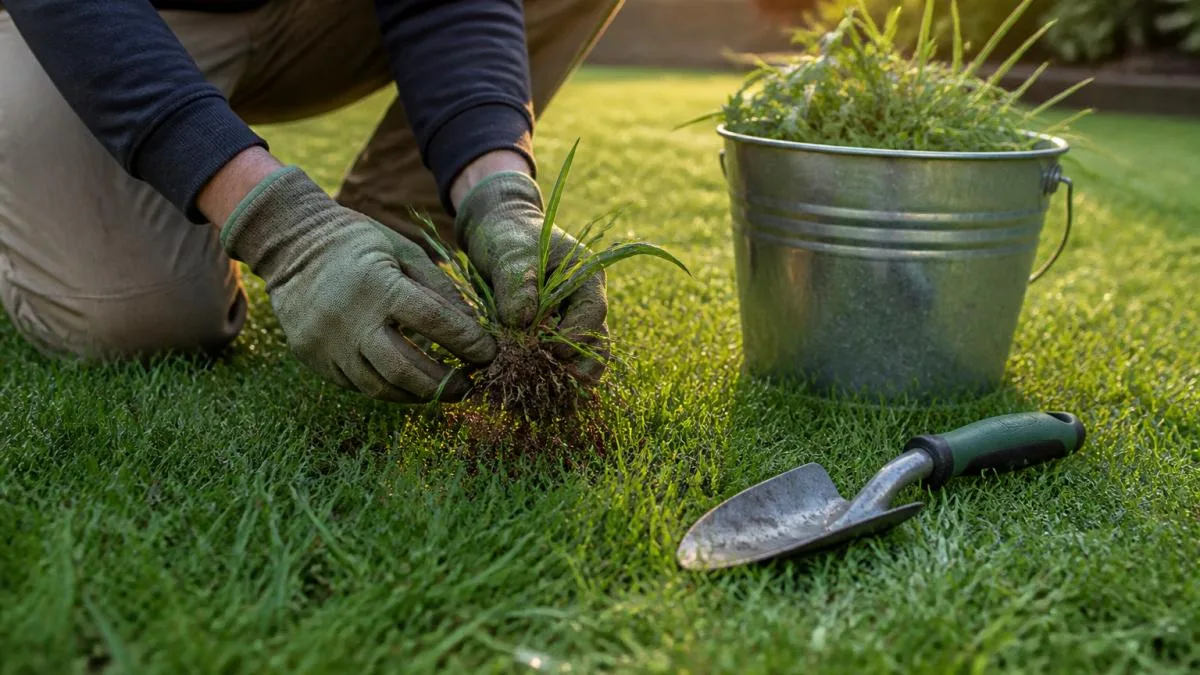
If the plant resists, loosen more soil. Yanking hard just tears the top off and leaves the crown behind.
When to Pull: Timing Around Germination
Crabgrass seed germinates when soil warms in late spring, and plants keep sprouting into summer.
Once a plant drops seed, you have added years of future weeds to your soil. A single plant can release thousands of seeds.
Timing varies by climate. In southern regions with early warmth, germination can start in early spring. In northern areas, it may not begin until late spring or early summer.
Safe Removal and Disposal of Seed-Bearing Plants
Seed heads make disposal a real concern. If you toss a seeding plant onto your compost pile or leave it on the lawn, those seeds can spread and start the cycle again.
Do this instead:
- Bag seeding plants and put them in the trash
- Never add them to home compost unless your pile runs hot enough to kill seed
- Do not shake seed heads over the lawn
Plants without seed heads can go into a regular yard waste bin.
Does Vinegar Kill Crabgrass? What You Need to Know
Vinegar can kill crabgrass, but only the top growth, and only on young plants. Household vinegar is too weak to do much. Even stronger horticultural vinegar burns foliage back while leaving roots alive, so the weed often regrows.
Here is the honest trade-off. Vinegar is non-selective, meaning it kills grass and garden plants it touches. In a flower garden or vegetable garden, that is a real risk. Overuse can also acidify soil over time.
Where vinegar helps:
- Spot-treating small weeds in sidewalk cracks
- Burning back young seedlings in gravel or mulch
Where it fails:
- Established clumps with deep crowns
- Any spot where you want surrounding grass to survive
Do not spray vinegar on a hot, sunny day and expect a clean kill. The top burns, the root survives, and you have wasted the effort. For established crabgrass, hand pulling is more reliable.
Best Mowing Height to Prevent Crabgrass
The best mowing height to prevent crabgrass is the tallest height your grass type tolerates, usually the top of the recommended range. Taller grass shades the soil, and crabgrass seed needs light to sprout.
Set your mower higher and follow a few habits:
- Never cut more than one-third of the blade at once (Enhance Lawn Health and Beauty with Proper Mowing (5-23-11))
- Keep blades sharp for a clean cut
- Mow on a schedule rather than scalping when the lawn looks shaggy
Scalping is the classic mistake. It stresses turf, opens bare spots, and hands crabgrass an open invitation.
Watering and Soil Care That Supports Thick Turf
Deep, infrequent watering grows deep roots and a denser lawn. Light daily sprinkling does the opposite. It wets only the surface, encourages shallow roots, and keeps soil moist enough for weed seed to sprout.
Water once or twice a week, long enough to soak several inches down. Let the surface dry between cycles. Aerate compacted soil in fall, and top-dress thin areas with compost to build better structure.
How to Prevent Crabgrass from Coming Back
Prevention comes down to blocking seed germination and growing dense turf. A thick lawn is the single best natural weed killer, because it crowds out weeds before they can establish.
Use these habits each season:
- Mow tall and never scalp
- Water deeply and less often
- Overseed thin spots in early fall
A pre-emergent product blocks seed germination, but it is a chemical tool. If you want a chemical-free plan, focus on turf density and timely hand pulling instead.
Overseeding to Crowd Out Weeds
Overseeding fills bare spots so crabgrass has nowhere to grow. Early fall is the best window for cool-season grasses, because soil stays warm while air cools, giving new seed time to root before winter.
Steps for a stronger lawn:
- Rake or core-aerate the thin areas.
- Spread seed at the rate on the bag for your grass type.
- Cover lightly with compost or a thin layer of topsoil.
- Keep the surface moist until seedlings establish.
- Stay off the new grass until it is tall enough to mow.
Recovering a Heavily Infested Lawn
A lawn that is more than half crabgrass needs a bigger plan, not just spot pulling. You are renovating a lawn, and the crabgrass is a symptom of turf that lost the competition for light, water, and space.
The realistic path is staged: suppress the weed, rebuild the soil, reestablish turf, and then defend it. Skipping stages is why so many renovation attempts fail by midsummer.
Stage 1: Stop the Seed Factory
Before anything else, prevent this year’s plants from adding to the seed bank. Every seed head you allow to mature sets you back years.
- Pull or hoe the worst patches first, working before seed heads form.
- Bag and trash all seeding material. Do not compost it unless your pile reliably runs hot.
- Do not shake soil off seeding plants back onto the lawn.
This stage is unglamorous and it will not make the lawn look better. It is still the highest-leverage work you will do, because it shrinks next year’s problem.
Stage 2: Decide Whether to Renovate or Rebuild
Not every infested lawn needs the same treatment. The decision comes down to how much desirable grass is left.
- Roughly half or less crabgrass, with decent turf between patches: Spot removal plus overseeding is usually enough. You are filling gaps, not starting over.
- Mostly crabgrass, with thin or bare ground underneath: Overseeding into a thick crabgrass stand rarely works, because the weed outcompetes young seedlings for light and water. This is where a full renovation makes more sense.
A full renovation means suppressing the existing vegetation, preparing a clean seedbed, and starting fresh. It is more work up front and it produces a more reliable result than fighting the same battle every spring.
Stage 3: Rebuild the Soil Before You Rebuild the Grass
New seed fails on compacted, depleted soil. Address the foundation first.
- Aerate to relieve compaction and let air and water reach the root zone. Core aeration, which pulls plugs, does more for compacted ground than spiking.
- Top-dress with compost to improve structure and add organic matter. A thin, even layer is enough. Smothering the surface with a thick blanket does more harm than good.
- Correct the pH if it is far off. A basic soil test tells you where you stand. Most turf grasses perform best in a slightly acidic range, and a large imbalance makes everything else harder.
Stage 4: Reestablish Turf at the Right Time
For cool-season grasses, early fall is the strongest window. Soil is still warm from summer, air is cooling, and seedlings get weeks of favorable growth before winter.
Steps for a stronger lawn:
- Rake or core-aerate the thin areas.
- Spread seed at the rate on the bag for your grass type.
- Cover lightly with compost or a thin layer of topsoil.
- Keep the surface moist until seedlings establish.
- Stay off the new grass until it is tall enough to mow.
Water newly seeded areas lightly and often at first, then transition to deeper, less frequent watering as roots develop. The goal is to push roots down, not to keep the surface permanently wet.
Stage 5: Defend the Investment
The first season after renovation is when the lawn either thickens into a self-defending stand or opens the door for a new crabgrass flush.
- Mow tall, at the top of the recommended range for your grass type.
- Never remove more than about a third of the blade height in one cut.
- Water deeply and infrequently to encourage deep roots.
Realistic Expectations
Natural control is slower than spraying, and anyone promising a one-week fix is overselling it. A heavily infested lawn typically takes a full season to turn around, and often two before it looks genuinely dense.
The reason is the seed bank. Crabgrass seed can remain viable in soil for years, so even a perfect renovation will see some germination the following spring from seed that was already there.
Do not expect a single season to empty the seed bank. Plan for declining pressure over two to three years, with each season easier than the last as long as you keep new seed from maturing.
Recovering a heavily infested lawn is a renovation, not a rescue. Stop the seed, fix the soil, reestablish turf at the right time, and defend it for a full season. Do the stages in order and the lawn gets stronger every year instead of resetting.
Frequently Asked Questions
Is it better to pull or spray crabgrass?
Pulling works best when the soil is moist and the plant is young, because you can remove the crown and roots in one motion. Spraying with a post-emergent herbicide kills the top growth but often leaves seeds behind. For a chemical-free approach, hand pulling combined with taller mowing and deep watering gives you the most control without harming pets, children, or pollinators.
Does vinegar kill crabgrass?
Household vinegar (5% acetic acid) burns the leaves of young crabgrass seedlings but rarely kills the roots, so the plant often regrows. Horticultural vinegar at 20% acetic acid works better on small weeds but can burn desirable grass and irritate skin. Use vinegar on sunny, dry days for spot treatment, and follow up by hand pulling any survivors.
How can I prevent crabgrass from coming back naturally?
Prevention comes down to three habits: mow tall (3 to 4 inches), water deeply once or twice a week instead of short daily sprinkles, and overseed thin areas in early fall. Thick turf crowds out crabgrass seedlings before they can establish. Removing seed heads before they drop also cuts next year’s germination dramatically.
Can overseeding help crowd out crabgrass?
Yes. Overseeding in early fall fills bare spots where crabgrass would otherwise germinate the following spring. A dense stand of cool-season grass leaves little room and little light for weed seedlings. Pair overseeding with core aeration for better seed-to-soil contact, and keep the new seed moist until it establishes.