
Table of Contents
- What Local Commercial Landscaping Service Providers Actually Handle
- Comparing Local Providers: What to Look For in 2026
- What a Commercial Grounds Maintenance Contract Should Include
- Commercial Landscaping Cost Per Month: What Drives Your Quote
- Hiring Commercial Landscaping Contractors: 7 Questions That Save You Money
- Red Flags When Vetting Local Commercial Landscaping Service Providers
- Conclusion: Building a Year-Round Grounds Plan That Holds Up
- Frequently Asked Questions
Last Updated: September 23, 2026
What Local Commercial Landscaping Service Providers Actually Handle
Local commercial landscaping service providers manage the full exterior of a business property, not just the lawn. That includes mowing, edging, seasonal color, irrigation checks, tree care, and snow removal, all under one contract. Clean Cut Property Maintenance handles this complete scope for commercial clients, which means property managers deal with one crew instead of five.
Commercial landscaping is the ongoing maintenance and improvement of business grounds, from turf and plant beds to parking islands and walkways.
The distinction matters more than most people realize.
Core Grounds Services vs. Specialized Work
Core services cover what happens every week: mowing, trimming, blowing, edging, and litter pickup. Specialized work runs on its own schedule.
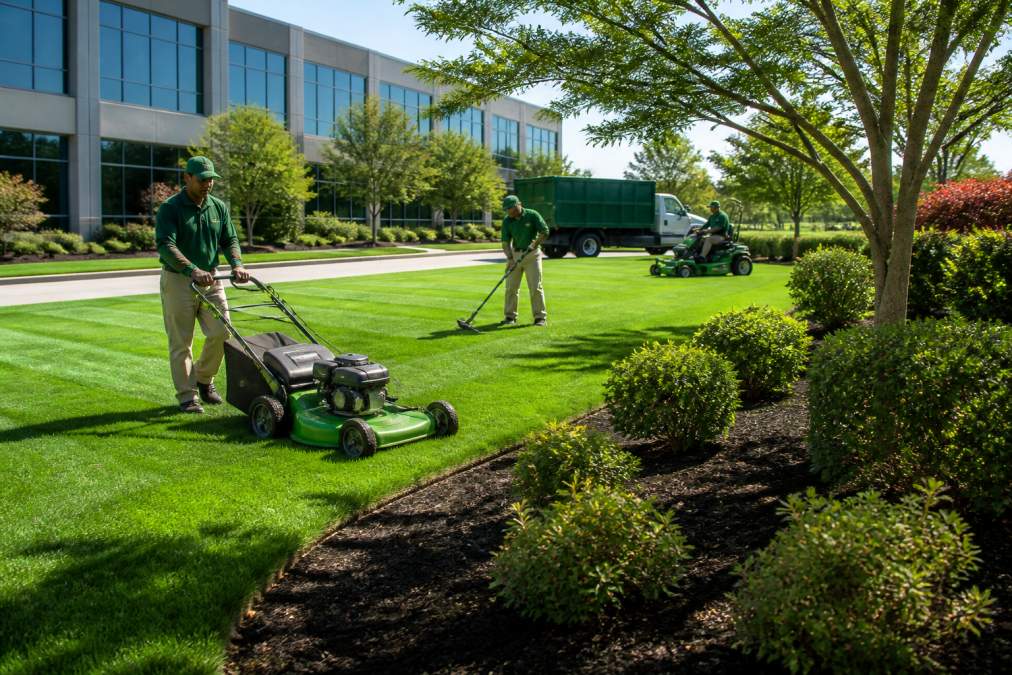
- Turf care: fertilization, aeration, overseeding, weed control
- Tree and shrub care: pruning, shaping, removal, stump grinding
- Irrigation: seasonal startup, winterization, head repair
- Seasonal color: annual rotations, mulch installation
- Snow and ice: plowing, salting, de-icing
A common mistake is hiring separate vendors for each line item. Coordination costs climb fast when three companies blame each other for the same dead shrub.
Ask any provider whether their crews are in-house or subcontracted. In-house teams control scheduling and quality; subcontractors add a layer of delay when something goes wrong.
Comparing Local Providers: What to Look For in 2026
Compare local providers on crew structure, equipment, and response time before you compare price. Those three factors predict service quality better than a bid sheet.
Feature Comparison: In-House Crews, Equipment, and Response Times
| Factor | What to Ask | Why It Matters |
|---|---|---|
| Crews | In-house or subcontracted? | Subcontractors add scheduling delays |
| Equipment | Commercial-grade mowers and plows? | Residential gear fails on large properties |
| Response time | Hours or days for callbacks? | Storm damage and irrigation leaks need same-day attention |
| Insurance | Liability and workers’ comp? | Protects you from on-site injury claims |
| Reporting | Photo updates or portal access? | Proof of service without site visits |
The single biggest differentiator is response time. Property managers report that slow callbacks during storm season cause more frustration than any pricing dispute.
What a Commercial Grounds Maintenance Contract Should Include
A commercial grounds maintenance contract should spell out scope, frequency, and what happens when work falls short. Vague contracts create disputes.
Every contract should define:
- Service schedule: weekly, biweekly, or monthly per task
- Scope per visit: exact tasks, not general promises
- Seasonal add-ons: snow triggers, spring cleanup, fall leaf removal
- Performance standards: what “acceptable” looks like
- Correction terms: how and when issues get fixed
- Term and renewal: length, notice period, escalation clauses
Contracts that list services without frequency or performance standards leave you with no use. If the crew skips edging for three weeks, you have no written basis to demand a fix.
Commercial Landscaping Cost Per Month: What Drives Your Quote
Commercial landscaping cost per month depends on property size, service frequency, plant density, and seasonal scope. No honest provider quotes a flat national rate, because no two properties match.
Pricing factors include:
- Square footage of turf and beds
- Visit frequency (weekly costs more than biweekly)
- Tree count and height (tall trees need specialized equipment)
- Irrigation complexity (zone count, controller type)
- Snow contract terms (per-push vs. seasonal flat rate)
The U.S. Small Business Administration’s guide to writing contracts offers a useful framework for structuring service agreements with clear deliverables.
Most providers quote after a site walk. Clean Cut Property Maintenance uses a custom quote process for the same reason: a phone estimate misses drainage issues, slope, and plant health.
Hiring Commercial Landscaping Contractors: 7 Questions That Save You Money
Hiring commercial landscaping contractors comes down to asking the right questions before signing. These seven separate serious operators from fly-by-night crews.
- Who actually shows up? In-house employees or day labor?
- What’s your callback window? Same day for emergencies?
- Can you handle tree work and pest control? Or do I need extra vendors?
- What happens if I’m unhappy? Is there a correction visit?
- How do you handle drainage and overgrown areas? Restoration or mowing only?
- What’s your insurance coverage? Liability and workers’ comp limits?
- Can I see a sample contract? Before I commit.
Question five matters most for neglected properties. Overgrown beds and standing water need restoration work, not a mow-and-go crew.
Red Flags When Vetting Local Commercial Landscaping Service Providers
Red flags in local commercial landscaping service providers usually show up before the first invoice. Watch for these.
- No written contract, just a verbal quote
- Payment demanded upfront for the full season
- No insurance certificate provided on request
- No local references from commercial clients
- Vague scope language like “general maintenance”
- No emergency contact for storm or irrigation failures
The most common complaint from property managers is inconsistent quality after the first month. Crews start strong, then rotate staff and standards slip. Ask how the provider maintains consistency across crews.
Consistency separates a good provider from a great one. Ask for the name of the account manager who will own your property, and confirm that person stays assigned.
Conclusion: Building a Year-Round Grounds Plan That Holds Up
A year-round grounds plan fails when it’s built around mowing alone. The properties that stay presentable through every season pair routine maintenance with tree care, irrigation management, and snow response under one contract.
Clean Cut Property Maintenance provides comprehensive residential and commercial services, full-service landscape design and installation, and specialized pest management and tree care, all through a custom quote process tailored to your property. You get one point of contact instead of a vendor list.
Get a Custom Quote from Clean Cut Property Maintenance and stop coordinating crews yourself.
Frequently Asked Questions
What services are included in commercial landscaping maintenance?
Commercial landscaping maintenance covers mowing, edging, trimming, blowing, fertilization, weed control, mulch installation, seasonal color, irrigation checks, and debris removal. Many local commercial landscaping service providers also handle tree trimming, pest management, and snow removal in winter. The scope varies by contract, so ask each provider for a written service list. Clean Cut Property Maintenance offers a full-service menu for both routine grounds care and specialized tree or pest work. Always confirm what is included versus billed as an extra.
How is a commercial landscaping cost per month calculated?
Monthly pricing depends on property size, turf acreage, plant bed count, service frequency, and whether you need irrigation repair, tree care, or snow removal. A retail plaza with weekly mowing and seasonal color will cost more per month than a small office lot on a biweekly schedule. Because rates vary by region and scope, request a custom quote instead of relying on national averages. Clean Cut Property Maintenance builds quotes around your specific property and service calendar.
How do I choose the right commercial landscaping company for my business?
Start by verifying local licensing, insurance, and years in business. Ask for references from similar properties, such as retail centers or office parks. Review a sample commercial grounds maintenance contract to see how they handle missed visits, weather delays, and quality complaints. Compare at least three providers on crew size, equipment, and response time. Hiring commercial landscaping contractors with a dedicated account manager usually means fewer surprises and faster fixes when something goes wrong.
How often should commercial properties be landscaped?
Most commercial properties need mowing every 7 to 14 days during the growing season, with edging and trimming each visit. Fertilization typically runs 4 to 6 times per year, and mulch refresh happens once in spring. Irrigation checks should occur monthly in summer. Winter snow removal is on-call, not scheduled. Your exact frequency depends on grass type, climate, and how polished the property must look. A written schedule in your contract keeps expectations clear.