
Last Updated: November 2, 2026
Quick Summary
Hiring a certified arborist is worth it for most homeowners with mature trees, especially when the job carries risk or the tree carries value. A certified arborist has passed an independent credential exam and keeps it current through continuing education, which matters because bad cuts and missed defects can take years to surface. For light cleanup you could do yourself, it is not worth it.
- A certified arborist must recertify through continuing education to keep the credential.
- Certification is a voluntary credential, not the same as a state or local license.
- Topping a tree to control its size forces weak regrowth and shortens its life.
- Verify the arborist’s certification in the credential body’s directory and confirm insurance in writing.
- Skip the credential for small limb cleanup, sapling pruning, and brush removal only.
Table of Contents
- What a Certified Arborist Actually Does for Your Trees
- Certified Arborist Cost: What You Pay For and Why
- Certified Arborist vs Tree Service: What’s the Difference?
- When Hiring a Certified Arborist Is Worth It (and When It Isn’t)
- How to Find a Certified Arborist and Verify Credentials
- Questions to Ask an Arborist Before You Sign Anything
- Comparing Arborist Estimates and Avoiding Costly Red Flags
- Get a Custom Quote for Your Tree Care
- Frequently Asked Questions
What a Certified Arborist Actually Does for Your Trees
Is hiring a certified arborist worth it? A certified arborist is a tree care professional who has passed an independent credential exam and keeps that credential current through continuing education.
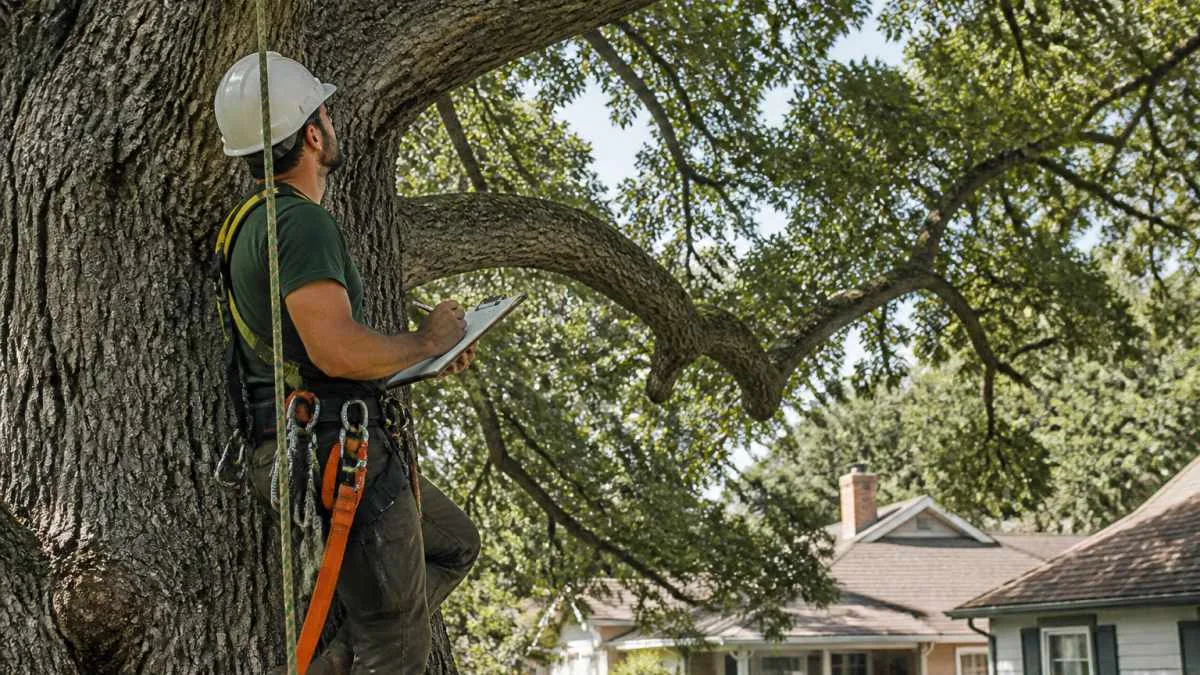
The credential matters because trees are slow to show damage. A bad cut or a missed defect can take years to surface. By then, the fix costs far more than the original job.
Tree Health Assessment and Diagnosis
A proper tree assessment starts above ground and ends below it. The arborist reads the canopy for thinning, dieback, or odd leaf color. Then come the trunk and bark, where cracks and seams hint at structural defects. Finally, the root system and soil conditions get a look.
Common problems a trained eye catches:
- Disease and pests that hide under bark or inside the canopy
- Soil compaction that starves roots of air and water
- Included bark, a weak joint where branch failure starts
A diagnosis without these checks is a guess.
Pruning, Removal, and Risk Assessment
Tree pruning is where technical knowledge shows fastest. The right cut heals. The wrong one invites decay.
A certified arborist follows industry standards for where and how to cut. They also know when removal is the safer call.
Watch out: topping a tree to “control” its size is one of the most damaging things a crew can do (Pruning Trees).
Certified Arborist Cost: What You Pay For and Why
Certified arborist cost runs higher than a general tree service, and the gap is mostly labor, equipment, and liability coverage. Pricing depends on tree size, access, risk, and the scope you approve, so no responsible provider quotes a flat rate before seeing the tree. What you can do is understand the cost drivers and compare bids on equal terms.
What Drives the Price
When comparing tree work quotes, ask each bidder how they priced yours:
- Tree size and species. Diameter at breast height, height, and wood density change the labor and rigging required. A mature oak with a wide canopy costs more to work than a same-height pine.
- Access and proximity. A tree in an open back yard is cheaper to remove than one over a roof, driveway, fence, or power drop. Tight access may require rigging, a crane, or an aerial lift instead of a climber.
- Risk and condition. Hazard trees with cracks, lean, included bark, or root damage take longer and require more rigging and planning. Dead wood is heavier and less predictable than live wood.
How Certified and Uncertified Bids Typically Diverge
On a straightforward ground-level limb cleanup, the credential adds little to the labor, so bids may land close together. On a hazardous removal near a structure, more planning, rigging, and insurance tend to raise the bid, which is why the price gap often tracks the gap in risk.
Do not assume certification guarantees a particular price. Two certified firms can bid very differently based on crew size, equipment, and schedule. Compare scope first, then price.
The Return-on-Investment Case
A cheap option can create a future bill larger than the savings in tree care. The mechanism is simple: trees compartmentalize wounds slowly, so a bad pruning cut or a missed structural defect may not show up for years. By the time decay or failure is visible, the fix is often removal rather than pruning, a much larger expense, plus potential damage to roofs, vehicles, fences, or landscaping.
Scenarios where the math tends to favor certified work include:
- Mature specimen trees. Replacing a large shade tree takes decades. Correct structural pruning protects that value; topping or flush cuts can shorten the tree’s life.
- Trees near structures. A failed limb over a roof can exceed the cost of the pruning that would have prevented it. A risk assessment is cheap relative to the damage it avoids.
- Disease and pest diagnosis. A wrong treatment wastes money and can spread the problem. A correct diagnosis targets the actual cause.
Treat the certified premium as insurance against expensive mistakes, not as a guarantee of quality. On low-risk work, the premium may be small. On high-risk work, it is usually the best money in the bid.
A Simple Way to Compare Bids
Put every estimate on the same page before you decide:
- Same trees, same scope, same stump and cleanup terms.
- Insurance certificates and credential status attached.
- Who performs the work, and whether a certified arborist is on site.
- Permit responsibility and any exclusions in writing.
- Payment schedule and start date.
If one bid is far below the others, find the line it left out before you treat it as a bargain.
Certified Arborist vs Tree Service: What’s the Difference?
The certified arborist vs tree service distinction comes down to credentials, not trucks. A tree service is any company that performs tree work. A certified arborist holds a professional credential from a recognized body and must recertify through continuing education to keep it. Those are different things, and the difference matters most on complex or hazardous jobs.
Certification Is Not Licensing
This is the distinction most guides skip. Professional certification is a voluntary credential that demonstrates knowledge and commitment to standards. It is not the same as a state or local license, and it does not replace permits.
Likewise, a credential does not guarantee workmanship or a specific outcome. It is evidence of training and a commitment to standards, not a warranty. The written scope, insurance, and references still do the heavy lifting.
A Decision Framework by Job Type and Risk
Use the job, not the label, to decide how much credential you need:
Certification is especially valuable when:
- The tree is large, mature, or a specimen you want to keep for decades.
- The work is near a house, driveway, fence, power drop, or other structure.
- The tree shows cracks, lean, included bark, dead limbs, or root damage.
A qualified, insured tree service may be sufficient when:
- You need ground-level limb cleanup after a storm.
- You are removing brush and debris only.
- The work is small, reachable, and far from structures and lines.
Do not DIY when:
- Anything requires climbing, a chainsaw above shoulder height, or work near power lines. Utility line work belongs to the utility or its qualified contractor.
Three Questions That Separate the Two Fast
- Does the company list a named certified arborist on staff, and will that person be on site?
- Can they show current liability insurance and workers’ compensation coverage?
- Will they put the full work scope, exclusions, and cleanup terms in a written estimate?
If any answer is no, keep looking, regardless of how the company describes itself.
A company name that includes “tree service” tells you nothing about credentials. Verify the individual arborist’s certification status in the credential body’s directory, and verify insurance with the certificate, not a verbal assurance.
When Hiring a Certified Arborist Is Worth It (and When It Isn’t)
Hiring a certified arborist is worth it when the job carries risk or the tree carries value. It is not worth it for light cleanup you could do yourself.
Worth it:
- A large tree near your house, driveway, or power lines
- Signs of a dead or dying tree, or a hazardous tree with cracks or lean
- Pruning that shapes long-term growth on a valuable specimen
Skip it:
- Small limb cleanup on the ground
- Sapling pruning you can safely reach
- Removing brush and debris only
Match the job to the credential before you call anyone.
| Situation | Hire a certified arborist? |
|---|---|
| Large tree near house, driveway, or power lines | Worth it |
| Dead, dying, or hazardous tree with cracks or lean | Worth it |
| Pruning that shapes long-term growth on a valuable specimen | Worth it |
| Disease and pests that need a real diagnosis | Worth it |
| Small limb cleanup on the ground | Skip it |
| Sapling pruning you can safely reach | Skip it |
| Removing brush and debris only | Skip it |
How to Find a Certified Arborist and Verify Credentials
Finding a certified arborist takes ten minutes of checking, not a phone book. Start with the credential body’s directory, then confirm the details yourself.
Use this checklist before you hire:
- Confirm the arborist’s name in the credential directory
- Ask for the certification number and check its status
- Request a certificate of liability insurance
What most guides miss is the insurance step. If a crew member is hurt on your property and the company has no workers’ comp, the claim can land on you.
Questions to Ask an Arborist Before You Sign Anything
Ask these questions before any contract, and listen for specifics rather than vague reassurance.
- Will you be the person doing the work, or who will?
- What exactly is included in the written estimate?
- How will you protect my lawn, fence, and roof during removal?
- What happens to the wood and debris?
- Do you carry liability insurance and workers’ comp?
- What is your cleanup process when the job is done?
- How do you handle emergency tree work?
A qualified professional answers each one without hedging. If they dodge the insurance question, walk away.
Comparing Arborist Estimates and Avoiding Costly Red Flags
Comparing competing estimates means comparing scope, not just the bottom line. Two bids can differ because one leaves out stump grinding or cleanup entirely.
Line up the estimates side by side and check:
- Same number of trees and same work scope
- Stump grinding included or extra
- Cleanup and hauling listed
Red flags to watch for:
- A verbal estimate with no written scope
- Pressure to sign on the spot
- No physical address or verifiable credentials
For a deeper look at warning signs, read our guide on signs of unreliable landscaping services. It covers the patterns we see most often.
Get a Custom Quote for Your Tree Care
The real test of whether a certified arborist is worth it comes down to your trees, your risk, and your budget.
We handle tree care, lawn and plant care, pest management, and landscape installation under one roof.
Ready to see what your trees need? Get a custom quote for your tree care and we will map out the work and the timeline before anything starts.
Frequently Asked Questions
How do I verify an arborist’s certification?
Ask for the arborist’s certification number and check it directly with the issuing body, such as the International Society of Arboriculture. Confirm the credential is current, not expired. Then ask for a certificate of insurance for both general liability and workers’ compensation, and call the insurer to confirm the policy is active. A certified arborist will share these details without hesitation. Any provider who dodges the request or promises to send paperwork later is a risk you should not take on.
Does hiring a certified arborist save money in the long run?
It often does, because the biggest costs in tree care come from doing the wrong work. Improper pruning cuts can leave a tree vulnerable to disease and pests, and removing a hazardous tree after it drops a limb on a roof costs far more than preventive care. A certified arborist assesses tree health, identifies structural defects early, and recommends maintenance that extends tree longevity. That said, not every job needs one. A simple removal of a small, healthy tree in an open yard is a case where a reputable tree service can handle the work.
What is the difference between a certified arborist and a tree service?
A certified arborist is an individual who has passed a credentialing exam and maintains continuing education in tree health, diagnosis, and industry standards. A tree service is a company that performs the physical work, and its crew members may or may not hold certifications. The best tree services employ or contract certified arborists for assessments and work scope planning. When you compare certified arborist vs tree service, ask who will actually evaluate your trees and write the work scope, not just who swings the chainsaw.
When should I hire a certified arborist instead of a general tree service?
Bring in a certified arborist when the job involves diagnosis rather than just labor. Signs of disease, dieback in the canopy, mushrooms at the base, or a tree leaning toward a structure all call for a tree risk assessment from a qualified professional. The same goes for mature or high-value trees you want to keep, and for any work near power lines or buildings. For routine pruning of small ornamentals or clearing brush, a licensed and insured tree service is usually sufficient.
Your trees will not tell you when a limb is about to fail. A trained set of eyes will. Clean Cut Property Maintenance brings certified tree care, full-service landscape maintenance, and a written scope to every job, so you know exactly what you are paying for. Get started with Clean Cut Property Maintenance and protect the trees, curb appeal, and value of your property.
