
Table of Contents
- Lawn Care vs Professional Landscaping: Core Differences
- Lawn Maintenance Services: Routine Tasks and Scope
- Landscape Design and Installation Services
- DIY vs Professional Lawn Maintenance: Making the Choice
- Understanding Lawn Care Service Cost and Pricing Factors
- Can One Company Handle Both Services?
- How to Choose the Right Service for Your Property
- Frequently Asked Questions
Last Updated: October 11, 2026
Lawn Care vs Professional Landscaping: Core Differences
Many property owners confuse lawn care vs professional landscaping, but they represent fundamentally different services with separate scopes, costs, and outcomes. Understanding the distinction is critical before hiring.
Lawn care focuses on the health and maintenance of your grass, soil, and existing plants. Professional landscaping encompasses design, installation, and structural improvements to your outdoor space. The confusion often costs property owners money because they hire the wrong service for their actual need.
What Lawn Care Actually Covers
Lawn care is maintenance that keeps what you have in good condition: mowing, edging, fertilization, weed control, pest management, and seasonal debris removal. A lawn care provider manages ongoing turf and plant health without redesigning your yard.
Routine lawn care prevents decline through regular mowing, fertilization to address nutrient deficiencies, weed control, and pest/disease management against grubs, chinch bugs, and fungal infections. These services occur weekly or biweekly during the growing season.
What Professional Landscaping Includes
Professional landscaping transforms your outdoor space through design, hardscaping, new plantings, grading, soil work, and structural installations like patios, retaining walls, and drainage systems, not just maintenance.
Professional landscapers assess your yard, identify drainage issues, recommend climate-suited plants, and create a cohesive visual plan. Installation of patios, mulch beds, walkways, lighting, and privacy screens falls under landscaping services.
Lawn Maintenance Services: Routine Tasks and Scope
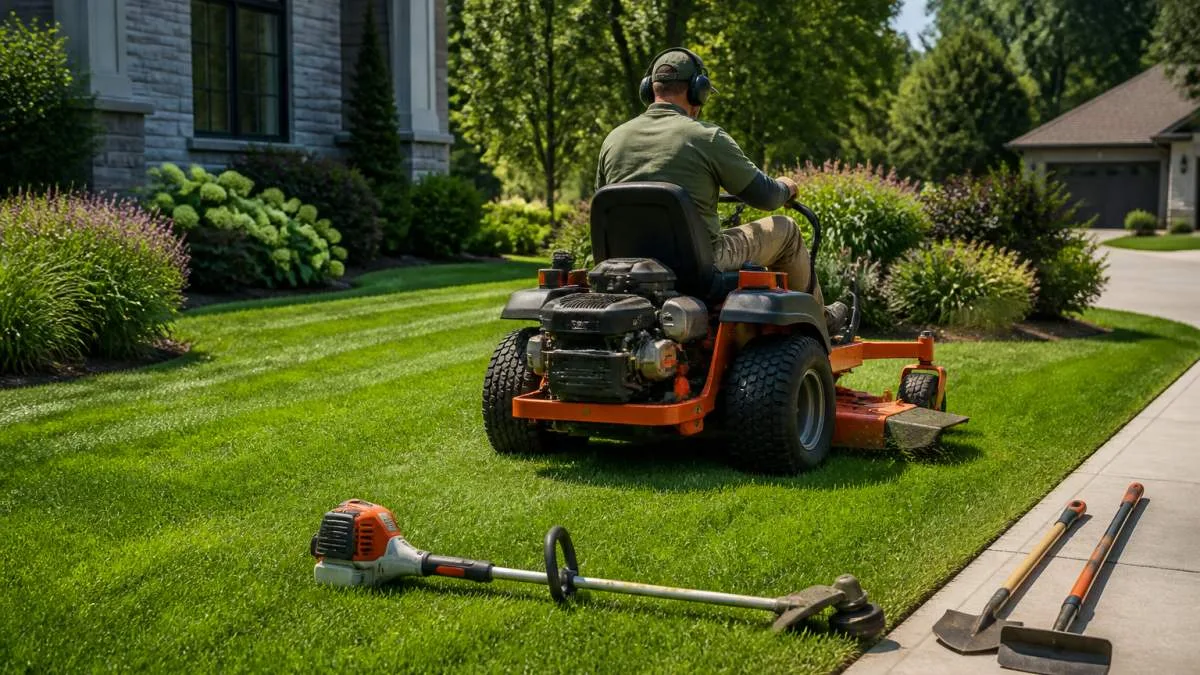
Mowing, Edging, and Trimming
Regular mowing is the foundation of lawn care. Grass cut at correct height resists weeds more effectively. Most residential lawns need weekly mowing during peak season, though frequency depends on grass type and rainfall.
Edging and trimming create clean borders and handle areas mowers cannot reach. These finishing touches define a well-maintained yard and are part of routine maintenance.
Fertilization, Weed Control, and Pest Management
Fertilization replenishes nitrogen, phosphorus, and potassium that grass depletes. A structured schedule of 4-6 applications per year keeps turf dense and resilient.
Weed control uses pre-emergent applications to stop seed germination and post-emergent treatments for existing weeds. Integrated pest management addresses grubs and chinch bugs before populations explode.
Seasonal Cleanup and Debris Removal
Spring cleanup removes winter debris, aerates soil, and prepares beds for plantings. Fall cleanup handles leaf removal and yard preparation for dormancy.
Storm cleanup is often handled by lawn care services, though major tree removal requires a specialized arborist. Seasonal services keep your yard functional and prevent debris damage.
Landscape Design and Installation Services
Design, Hardscaping, and New Plantings
Landscape design transforms your vision into a functional outdoor space by assessing your property, understanding goals, and balancing aesthetics, function, and maintenance.
Hardscaping includes patios, walkways, retaining walls, drainage systems, and lighting. These structural improvements enhance usability and solve problems like poor drainage or erosion.
New plants are selected for climate compatibility and soil conditions, then planted at correct depth and spacing for healthy establishment.
Yard Restoration and Problem Solving
Some yards need restoration before routine maintenance makes sense. Overgrown areas require clearing and grading. Compacted soil needs aeration and amendment. Erosion problems demand grading adjustments and stabilization plantings.
Yard restoration combines landscape design with intensive labor to identify root causes, poor drainage, soil compaction, wrong plant selection, and implement lasting solutions.
DIY vs Professional Lawn Maintenance: Making the Choice
Time, Physical Demand, and Skill Requirements
DIY lawn maintenance requires consistent time commitment. Mowing a half-acre takes 1-2 hours weekly; add edging, trimming, fertilization, and weed control, and you’re investing 50-100+ hours annually over a 6-month season.
Physical demands are real: operating a mower and spreader is strenuous for many homeowners, especially those with mobility limitations or health conditions. Skill requirements vary from basic mowing to pest identification and disease diagnosis.
When Professional Service Pays Off
Professional service makes sense when time is limited, physical capability is constrained, or your yard has complex needs. Commercial property managers benefit from professional lawn care for consistent curb appeal.
Homeowners selling soon should hire professional landscaping to maximize curb appeal. Yards with drainage problems, pest infestations, or poor soil health benefit from professional diagnosis. Properties with mature trees or specialty plants warrant professional expertise.
Understanding Lawn Care Service Cost and Pricing Factors
Typical Pricing Models and Service Tiers
Per-visit pricing ($50-$150 per visit) works for homeowners wanting flexibility but often costs more than bundled service.
Monthly recurring service ($150-$400/month for a quarter-acre) spreads cost and ensures consistent scheduling.
Seasonal packages bundle maintenance with specialized treatments. A four-application fertilization program costs $300-$800 annually; pest management adds $200-$600 per year. Seasonal packages often cost 15-25% less than à la carte service.
Landscape installation is project-based. Patio installation ranges $1,500-$5,000+; yard restoration typically costs $2,000-$10,000+ for a quarter-acre.
What Drives Your Actual Quote
Several factors directly affect the price you’ll receive:
Property size is the primary driver. Quarter-acre lawns cost less than half-acre; commercial properties cost significantly more.
Complexity and accessibility add cost. Steep slopes, mature trees, extensive beds, and obstacles increase labor time and per-visit cost.
Regional labor costs vary significantly. Urban areas charge more than rural regions; pest pressures and growing season length affect treatment frequency.
Service frequency influences pricing. Weekly mowing costs more than biweekly; more frequent fertilization costs more than a standard four-application program.
Specialized treatments add cost. Organic fertilization costs 20-40% more than synthetic; integrated pest management costs more than reactive treatment.
One-Time Projects vs Recurring Service: Budget Planning
Recurring lawn care service creates predictable costs ($200-$300/month or $1,200-$1,800 annually) and prevents decline that leads to expensive restoration.
One-time landscape projects ($3,000-$8,000) solve problems permanently and add property value.
Hybrid approach: Combine recurring lawn care ($1,500-$2,000 annually) with periodic improvements ($2,000-$5,000 every 3-5 years) to spread investment and prevent costly restoration.
Verifying Credentials and Insurance
Pesticide applicator license: Any provider applying herbicides, fungicides, or insecticides must hold a state commercial pesticide applicator license. Ask to see it.
General liability insurance: Reputable providers carry $1 million minimum coverage. Request a certificate of insurance.
Workers’ compensation insurance: Required if the company employs staff; protects you from liability.
Bonding: Some states require landscape contractors to be bonded. Verify requirements in your state.
Can One Company Handle Both Services?
Many landscaping companies offer both lawn care and design services. A single provider understands your property and can recommend improvements that reduce future maintenance.
However, not all lawn care providers do design and installation, and not all landscape designers handle ongoing maintenance. When selecting a service provider, clarify which services they offer. According to industry guidance on professional landscaping standards, comprehensive service providers should have expertise in both maintenance and design.
Clean Cut Property Maintenance handles both lawn care and landscape services, eliminating the need to coordinate multiple contractors.
How to Choose the Right Service for Your Property
Property-Specific Decision Framework
Step 1: Assess Current Condition
Evaluate your yard: Is the lawn healthy or thin and patchy? Are plants thriving or stressed? Are there functional problems like poor drainage or erosion? Is the yard well-organized or overgrown?
A healthy lawn with minor maintenance needs is a lawn care candidate.
A declining or problem-filled yard needs landscape restoration before routine maintenance. Lawn care alone won’t fix drainage issues, compaction, or pest infestations.
Step 2: Define Your Goal
What do you want to achieve?
- Maintain current appearance → Lawn care
- Improve curb appeal for sale → Professional landscaping (design + installation)
- Solve a specific problem → Landscape restoration
- Transform the space → Landscape design and installation
- Long-term improvement → Combination approach: restoration/design, then recurring lawn care
Step 3: Evaluate Your Constraints
Realistic constraints narrow your options:
Time availability: If time is limited or you prefer not to spend it on yard work, hire lawn care.
Physical capability: Mobility limitations, age-related decline, or health conditions make professional service essential.
Budget:
- Tight ($500-$1,000 annually): DIY mowing; hire for specialized treatments only.
- Moderate ($1,500-$3,000 annually): Recurring lawn care with seasonal packages; landscaping every 3-5 years.
- Flexible ($3,000+ annually): Full-service lawn care plus periodic improvements.
Timeline: When do you need results?
- Immediate (within 4 weeks): Hire lawn care for quick cleanup and mowing; landscape installation for new features.
- This season (within 3-4 months): Landscape restoration or new installation; lawn care to establish and maintain.
- Long-term (6+ months): Recurring lawn care with periodic improvements; allows time for plants to establish and soil to respond to treatment.
Step 4: Match Your Situation to Service Type
Use this decision matrix:
| Situation | Primary Service | Secondary Service | Timeline |
|---|---|---|---|
| Healthy lawn, limited time | Lawn care (recurring) | Seasonal cleanup | Ongoing |
| Healthy lawn, selling soon | Professional landscaping (design + install) | Lawn care (pre-sale) | 2-4 months |
| Declining lawn, drainage issues | Landscape restoration | Recurring lawn care after | 1-2 seasons |
| Overgrown yard, pest problems | Yard restoration + pest management | Lawn care maintenance | 1-2 seasons |
| Healthy lawn, want improvements | Landscape design + installation | Lawn care (ongoing) | 1 season |
| No time, no budget for projects | Basic lawn care (mowing only) | Seasonal cleanup | Ongoing |
| Healthy lawn, want premium appearance | Full-service lawn care (fertilization + pest mgmt) | Periodic design updates | Ongoing |
Seasonal Timing and Coordination
When you hire matters. Spring and fall are peak seasons for both lawn care and landscaping; scheduling early improves availability and quality.
Spring (March-May): Ideal for lawn care startup, aeration, soil amendment, and new plantings.
Summer (June-August): Peak lawn care season with weekly mowing and pest management. Landscape installation continues but heat stress affects new plant establishment.
Fall (September-November): Second peak season for landscape installation and yard restoration. Lawn care includes aeration, overseeding, and fall cleanup.
Winter (December-February): Minimal lawn care in cold climates; dormant season maintenance and planning. Mild climates may continue mowing.
Coordination tip: If you’re combining lawn care with landscape installation, start design and installation in spring or fall when conditions favor plant establishment.
Setting Realistic Expectations
Understand what each service delivers and when:
Lawn care results: Consistent professional lawn care shows measurable improvement in turf density and color within 8-12 weeks. After one full growing season (4-6 months), a previously declining lawn becomes noticeably healthier. Weed populations decrease, bare spots fill in, and overall appearance improves. Results are incremental but cumulative.
Landscape installation results: New hardscape features (patios, walls, walkways) are complete and usable immediately. New plants take time to establish. Shrubs and trees show visible growth within one season but reach mature size over 3-5 years.
Restoration results: Yard restoration addressing drainage, compaction, or erosion takes 1-2 seasons. Soil amendment improves structure gradually. New plantings establish over the first year. Functional improvements (drainage, erosion control) may show results within weeks but full stabilization takes a season or more.
Set expectations with your service provider upfront. Ask for a timeline specific to your project, not generic promises. A reputable provider explains what to expect month by month and what conditions (weather, plant response, soil conditions) might affect the timeline.
Frequently Asked Questions
Is landscaping and lawn care the same thing?
No. Lawn care focuses on routine maintenance like mowing, fertilization, weed control, and pest management to keep existing grass healthy. Professional landscaping includes design, installation, hardscaping, and structural changes to your yard. You can have lawn care without landscaping, but comprehensive landscaping typically includes ongoing lawn maintenance services to preserve the finished look.
When should I hire a landscaper instead of a lawn care company?
Hire a landscaper when you need design work, new plantings, hardscaping (patios, walls, grading), or yard restoration. Hire a lawn care company for routine grass maintenance, fertilization, and seasonal cleanup. If your yard needs both, many professional services handle both lawn care and landscape design and installation, which eliminates coordinating multiple contractors.
What services are included in professional lawn care?
Professional lawn maintenance services typically include mowing and edging, fertilization and soil treatments, weed and pest control, disease management, seasonal cleanup, and debris removal. The exact scope depends on your service agreement. Some providers also offer specialized care for trees and shrubs as part of their lawn care package.
How does DIY vs professional lawn maintenance affect my property value?
Professional lawn maintenance services deliver consistent, expert care that keeps your lawn and landscape healthy year-round, which directly supports curb appeal and property value. DIY maintenance works if you have the time and knowledge, but inconsistent care, missed treatments, or improper techniques can damage turf health and appearance. For properties being prepared for sale or commercial properties where appearance matters, professional service typically provides better returns.