
Last Updated: October 30, 2026
Quick Summary
Yes, commercial landscaping can increase property value by improving what appraisers and buyers will pay and what tenants will pay to occupy the space. It feeds the condition and appeal adjustments appraisers apply, and healthy grounds can influence leasing decisions and tenant retention.
- Appraisers rarely list landscaping as its own line; it feeds condition and appeal adjustments against comparable sales.
- Annual ROI equals added rent, retained rent, turnover savings, operating savings and value uplift divided by first-year cost.
- Plan three cost layers: routine upkeep, cyclical renewal, and capital replacement on a multi-year rhythm.
- Prioritize entrance and signage beds, turf recovery, irrigation repair, tree care, and drainage correction first.
- Low-maintenance landscaping with zoned irrigation costs more upfront but far less over a decade.
Table of Contents
- Does Commercial Landscaping Increase Property Value? The Short Answer
- How Commercial Property Curb Appeal Drives Tenant Interest and Saleability
- Calculating Commercial Landscaping ROI Before You Spend
- Commercial Landscape Maintenance Costs and Lifecycle Planning
- High-Value Commercial Landscaping Improvements Worth Prioritizing
- Professional Landscaping vs. DIY: What Pays Off for Commercial Properties
- Get a Custom Quote for Your Commercial Property
- Frequently Asked Questions
Does Commercial Landscaping Increase Property Value? The Short Answer
Yes, commercial landscaping can increase property value, and the effect shows up in two places: what appraisers and buyers will pay for the property, and what tenants will pay to occupy it. Clean Cut Property Maintenance works with commercial property managers and business owners on exactly this question, and the answer depends on which improvements you choose.
Commercial landscaping is the planned design, installation, and ongoing maintenance of the grounds around a commercial property, covering lawns, trees, shrubs, garden beds, irrigation, drainage, and hardscape edges. It is a capital and operating decision, not a cosmetic one.
Here is the part most guides get wrong: they treat landscaping as a single line item. It isn’t. A parking lot island of dead shrubs and a properly irrigated entrance bed are both “landscaping,” but only one of them changes what a buyer or tenant is willing to sign for. Below, we break down the appraisal logic, a working ROI formula, real maintenance cost planning, and the specific improvements that pay back fastest.
What the Appraisal and Leasing Evidence Actually Shows
Appraisers value land and improvements using the sales comparison, income, and cost approaches. Landscaping rarely appears as its own line. Instead, it feeds the “condition” and “appeal” adjustments that appraisers apply when comparing your property to comparable sales data published by Fannie Mae and local market records. A property with healthy, mature plantings and clean edges reads as well-maintained; deferred landscaping reads as deferred maintenance, and appraisers discount for it.
On the leasing side, the logic is more direct: tenants comparing similar spaces tend to weigh the appearance of the grounds, which can influence leasing decisions.
How Commercial Property Curb Appeal Drives Tenant Interest and Saleability
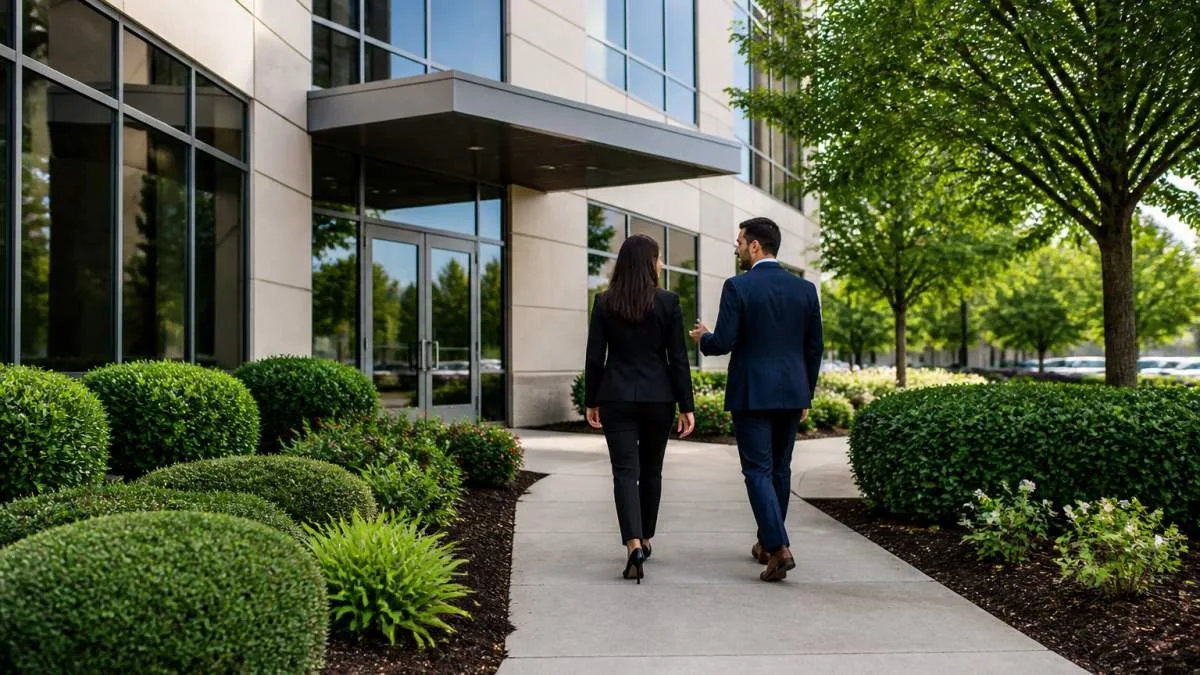
First impressions often form in the parking lot as well as in the lobby, and overgrown beds, patchy turf, and cracked walkway edges can signal that a property is not well maintained.
Curb appeal can influence several outcomes that matter to property owners, including leasing, tenant retention, and saleability.
Calculating Commercial Landscaping ROI Before You Spend
Most owners skip this step and spend what feels reasonable, which is how landscaping budgets get cut first when occupancy dips. A commercial landscaping ROI calculation forces the conversation onto outcomes instead of appearances, and unlike the residential guides, it has to account for maintenance drag, property type, and tenant mix.
A Working Framework, Step by Step
Annual ROI = (Added rent + Retained rent + Reduced turnover cost + Operating savings + Value uplift at sale) ÷ Total first-year cost
Work it in five steps:
- Estimate added or protected rent. If improved grounds support even a small rent premium per square foot, multiply by leasable area. If they prevent one vacancy, the protected rent is the annual rent on that space.
- Add turnover savings. Every avoided vacancy carries lost rent, leasing commissions, and tenant improvements. Estimate the cost of one turnover and multiply by the vacancies you expect the improvement to prevent.
- Add operating savings. Efficient irrigation, right-sized plantings, and corrected drainage reduce water use, plant replacement, and emergency repair. These are real dollars against the maintenance budget.
- Estimate value uplift at sale. Capitalize the sustained net income increase at your market cap rate. A rent or occupancy gain that persists is worth far more than its first-year cash effect.
- Divide by total first-year cost. Include design, installation, irrigation, drainage, and the first year of maintenance, not just plant material.
A Worked Example (Illustrative)
Use your own numbers, but the structure looks like this for a small office property:
- Added rent: a modest premium per square foot on leasable area, annualized.
- Retained rent: one avoided vacancy at the current rent for that suite.
- Turnover savings: one avoided turnover at your typical commission and tenant-improvement cost.
- Operating savings: reduced water and plant replacement versus the prior year.
- Value uplift: the sustained net income gain divided by your cap rate.
Sum the annual and one-time benefits, divide by first-year cost, and compare against your other capital priorities. A project that adds rent and prevents one vacancy usually clears its cost quickly. A project that only looks better on opening day does not.
Property-Type and Tenant-Specific Priorities
Landscaping is not one-size-fits-all. Weight the ROI inputs differently by asset:
- Office, entrance beds, sightlines, and usable outdoor seating support tenant retention and recruiting image.
- Retail centers, visibility, signage beds, and foot-traffic-friendly walkways drive customer visits and tenant sales.
- Industrial, drainage, durable low-maintenance plantings, and clear truck and pedestrian routes reduce liability and operating cost.
- Multifamily, usable green space, seating, and seasonal color support leasing velocity and renewal rates.
- Hospitality, grounds are part of the product; invest where guests photograph and gather.
Maintenance Drag on Net Returns
Installation is the cheap part. Maintenance is where commercial landscape costs accumulate and where ROI quietly erodes. Plan three cost layers: routine upkeep (mowing, edging, weeding, irrigation checks), cyclical renewal (mulch, pruning, plant replacement), and capital replacement (irrigation rebuilds, tree removal, hardscape repair). The lifecycle mistake is planting for installation cost instead of maintenance cost, a high-input scheme looks excellent in year one and consumes the budget by year three. Low-maintenance landscaping with correctly zoned irrigation and regionally appropriate plant selection costs more upfront and far less over a decade, which is what makes the ROI hold.
Skipping a fall irrigation blowout or a spring drainage inspection can turn a small repair into a walkway or foundation problem, and those bills dwarf the maintenance savings.
Commercial Landscape Maintenance Costs and Lifecycle Planning
Installation is the cheap part. Maintenance is where commercial landscape maintenance costs accumulate, and where most budgets quietly fail.
Plan on three cost layers:
- Routine upkeep: mowing, edging, bed weeding, seasonal color, and irrigation checks on a recurring schedule.
- Cyclical renewal: mulch refresh, pruning cycles, and plant replacement as material ages out.
- Capital replacement: irrigation rebuilds, tree removal, and hardscape repair, which arrive on a multi-year rhythm rather than annually.
The lifecycle mistake we see most often is planting for installation cost instead of maintenance cost. A high-input planting scheme looks excellent in year one and consumes the budget by year three. Low-maintenance landscaping with correctly zoned irrigation and regionally appropriate plant selection costs more upfront and far less over a decade.
Watch out: skipping a fall irrigation blowout or a spring drainage inspection can turn a small repair into a walkway or foundation problem, and those bills dwarf the maintenance savings.
Plan your commercial landscape budget around three cost layers so maintenance costs don’t quietly erode your returns. For concrete pricing benchmarks, see the Commercial Grounds Maintenance Service Pricing Guide.
| Cost layer | What it covers | Timing |
|---|---|---|
| Routine upkeep | Mowing, edging, bed weeding, seasonal color, irrigation checks | Recurring schedule |
| Cyclical renewal | Mulch refresh, pruning cycles, plant replacement as material ages out | As material ages out |
| Capital replacement | Irrigation rebuilds, tree removal, hardscape repair | Multi-year rhythm, not annually |
High-Value Commercial Landscaping Improvements Worth Prioritizing
Not all improvements carry equal weight. Ranked by return, these commercial landscaping improvements tend to pay back fastest:
- Entrance and signage beds. The highest-visibility square footage on the property. Refresh mulch, edge cleanly, and replace struggling plants with reliable material.
- Turf recovery and irrigation repair. Patchy grass and broken heads read as neglect faster than almost anything else.
- Tree care and canopy management. Mature trees are an asset until a limb becomes a liability. Structural pruning and hazard removal protect both value and safety.
- Drainage correction. Standing water kills plantings, damages pavement, and creates slip liability. Fix it before planting over it.
- Usable outdoor space. Seating areas and walkable green space increase tenant appeal, particularly for office and mixed-use properties.
Planting Trees, Shrubs, and Flowers That Hold Up Over Time
Plant selection is where long-term cost is decided. Choose species that match your hardiness zone, soil, and sun exposure rather than what looks best in the nursery. Group plants by water need so irrigation zones can run efficiently, and favor shrubs with predictable growth habits that won’t outgrow their beds and require constant shearing. Seasonal flowers belong in contained beds where replacement is simple, not scattered through permanent plantings.
Professional Landscaping vs. DIY: What Pays Off for Commercial Properties
DIY makes sense for a small owner-occupied building with light upkeep. It stops making sense the moment you have tenants, liability exposure, and a property that needs to look consistent year-round. Commercial grounds require equipment, scheduling discipline, and someone accountable when a bed floods or a tree drops a limb.
The real difference between professional landscaping and DIY on a commercial property comes down to consistency and risk. A crew that shows up on schedule keeps small problems small. A well-intentioned owner with a trimmer usually doesn’t, and the gap compounds season after season. If you decide to hire a pro, How to Choose Commercial Landscaping Contractors walks through vetting them.
Get a Custom Quote for Your Commercial Property
The challenge is straightforward: landscaping only increases property value when it is planned around your property type, your tenants, and your maintenance capacity, and most owners never get that plan. Clean Cut Property Maintenance provides comprehensive residential and commercial services, full-service landscape design and installation, and specialized tree care. You can review our commercial landscaping services or contact our team directly to get a custom quote for your property.
Get started with Clean Cut Property Maintenance and put a grounds plan behind your property value.
Frequently Asked Questions
Does commercial landscaping increase property value?
Yes, when it is planned as a property improvement rather than routine mowing. Commercial landscaping improves curb appeal, which shapes buyer and tenant perception during showings and appraisals. The size of the value increase depends on property type, local comparable sales, and how well the grounds are maintained over time. A focused upgrade to entrances, signage beds, and parking-lot islands usually has a clearer effect on perceived value than scattered plantings, and pairing it with a maintenance plan protects the gain.
What is commercial landscaping ROI and how do I estimate it?
Commercial landscaping ROI compares the cost of an improvement against the value it adds through higher rent, faster leasing, or a stronger sale price. Estimate it by adding the installation cost and the first year of maintenance, then comparing that total with the rent premium or sale-price difference you expect. Because pricing depends on property size, plant selection, and site conditions, ask for a custom quote rather than relying on national averages. Track occupancy and leasing time before and after to confirm the return.
Which commercial landscaping improvements add the most value?
Start with the areas tenants and buyers see first: entrances, signage beds, parking islands, and walkways. Healthy trees and well-defined garden beds with seasonal color read as cared-for grounds. Usable outdoor space, such as a seating area or shaded walkway, can also strengthen tenant appeal. Low-maintenance plant selection and working irrigation and drainage protect those improvements. Avoid expensive one-off features that require constant upkeep, because maintenance costs can erase the value they add.
How much should a commercial property owner spend on landscaping?
There is no single figure, because commercial landscape maintenance costs vary with square footage, plant density, irrigation, and seasonal needs. A practical approach is to set a budget that covers routine upkeep plus one improvement project per year, then measure the effect on occupancy and leasing interest. Request a custom quote that separates recurring maintenance from installation so you can see the ongoing commitment. Spending should follow the property’s rent level and the expectations of its tenants.
