
Table of Contents
- What Affects Monthly Lawn Maintenance Cost
- Lawn Mowing Service Cost Breakdown
- Lawn Care Cost Per Month by Service Type
- Biweekly Lawn Mowing vs. Weekly Service
- Using a Lawn Maintenance Cost Calculator
- How to Compare Quotes and Avoid Hidden Fees
- DIY vs. Professional Lawn Maintenance
- Annual Budgeting and Off-Season Planning
- Frequently Asked Questions
Last Updated: October 20, 2026
What Affects Monthly Lawn Maintenance Cost
The average cost for monthly lawn maintenance varies based on a handful of concrete factors. Understanding what drives pricing helps you budget and compare quotes without hidden-fee surprises.
The primary drivers are lawn size, services needed, and location. These compound: a small yard in a low-cost region costs far less than a sprawling property in an expensive market, but a small yard needing intensive treatments can exceed basic mowing on a larger lot.
Lawn Size and Property Dimensions
Lawn size is the most straightforward pricing variable. Most providers charge by square footage, and the relationship is roughly linear: double the lawn, roughly double the cost per visit.
Mowing time scales with area: a 5,000 square foot lawn takes 30-45 minutes, while 20,000 square feet takes 90-120 minutes. Labor dominates cost, so larger properties cost more.
Size also interacts with terrain. A flat, open quarter-acre costs less than one with slopes, obstacles, trees, and narrow passages.
Service Scope and Frequency
Basic mowing differs fundamentally from comprehensive care. A provider who mows and edges weekly incurs different costs than one managing weed control, fertilization, and aeration alongside mowing.
Frequency matters too. Weekly service doubles the number of visits versus biweekly, affecting both your monthly bill and the provider’s ability to offer lower per-visit rates.
Growing season demands more frequent mowing, while winter typically requires minimal maintenance. Some providers offer year-round contracts with adjusted off-season pricing; others operate seasonally.
Regional and Seasonal Variations
Geography drives significant cost differences. Labor rates, fuel, equipment, and local competition vary by region, so a monthly contract in a high-cost metro typically exceeds the same service in a rural area.
Seasonal demand influences pricing. Spring and early summer are peak season, and pricing often reflects that demand; late fall and winter offer lower rates.
Climate affects maintenance needs directly: longer growing seasons require more frequent mowing, heavy rainfall demands more weed and disease management, and dry climates may require irrigation oversight.
Lawn Mowing Service Cost Breakdown
Mowing is the foundation of most lawn maintenance contracts. Understanding its cost structure helps you evaluate whether adding other services makes financial sense.
Cost Per Mowing Visit
A single mowing visit ranges based on lawn size and complexity.
The cost per visit also reflects what’s included. Basic mowing costs less than mowing plus edging, blowing, and cleanup.
When comparing quotes, ask explicitly what’s included: edging driveways and walkways, blowing debris off hardscapes, trimming around trees and obstacles. These details separate a $35 visit from a $55 visit for the same lawn.
Mowing, Edging, and Trimming
Edging and trimming add measurable cost and time to each visit. Edging creates clean lines between lawn and hardscape; trimming handles grass around trees, fences, and obstacles the mower can’t reach.
A professional who edges and trims thoroughly takes 15-25% longer than one who mows only, and this compounds across weekly or biweekly visits.
Some providers bundle edging and trimming into their base rate; others charge separately.
Lawn Care Cost Per Month by Service Type
Monthly costs vary dramatically based on service scope, from basic mowing to comprehensive care with treatments and specialty services.
Basic Lawn Care Packages
A basic monthly package typically includes mowing, edging, and trimming on a regular schedule (usually weekly or biweekly), the most common residential service.
Basic packages assume standard conditions: healthy growth, manageable weeds, and no pest problems. If your lawn is struggling, heavily weeded, or pest-infested, you’d need to upgrade or add services.
The advantage is predictability: you know the monthly cost, frequency, and what to expect.
Fertilization and Weed Control Pricing
Adding fertilization and weed control increases monthly costs but transforms lawn health. These are typically add-ons rather than included in base mowing rates.
Fertilization schedules vary; a common approach is 4-6 applications per year timed to the growing season, spring for new growth, summer for vigor, fall for dormancy preparation.
Weed control comes in two forms: pre-emergent (prevents weeds before they sprout) and post-emergent (kills existing weeds). Pre-emergent is more cost-effective because it prevents the problem.
Specialty Treatments and Add-Ons
Beyond mowing and basic treatments, specialty services command higher fees.
Aeration loosens compacted soil, improving water and nutrient penetration. It’s typically done once or twice yearly, in spring or fall.
Pest and disease management requires diagnosis and targeted treatment. A lawn struggling with grubs, chinch bugs, or fungal disease needs specific interventions.
When evaluating specialty services, ask whether they’re necessary for your specific lawn. A healthy, dense lawn with no pest history may not need these treatments.
Biweekly Lawn Mowing vs. Weekly Service
The choice between weekly and biweekly mowing affects both cost and lawn appearance.
Weekly mowing keeps grass at a consistent, manicured height.
Biweekly mowing reduces costs by roughly 40-50% compared to weekly service. The lawn tolerates biweekly mowing if grass growth is moderate.
The decision often depends on growing season intensity and personal preference.
Biweekly service also affects visual consistency. For homeowners selling their property or prioritizing curb appeal, this difference matters.
Using a Lawn Maintenance Cost Calculator
Many lawn care providers offer online calculators that estimate monthly costs based on lawn size, service frequency, and add-ons.
Calculators work best when you have accurate lawn dimensions. Overestimating square footage skews the estimate high. Underestimating skews it low.
The limitations of calculators are important to understand. They can’t account for terrain complexity, obstacle density, or regional labor rate variations.
Use calculators to establish a rough budget range. Then request formal quotes from local providers who can assess your specific property.
How to Compare Quotes and Avoid Hidden Fees
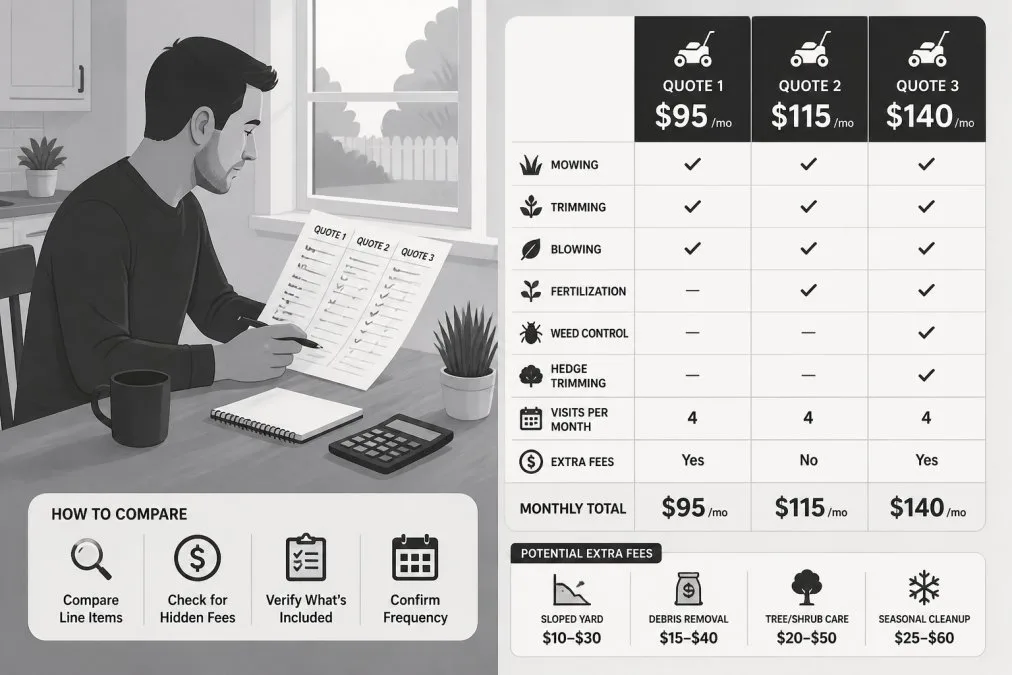
Getting multiple quotes is essential, but comparing them requires care. Quotes that look identical at first glance often differ significantly in what’s included.
What to Ask Your Service Provider
When requesting a quote, ask specific questions that reveal what’s included and what costs extra:
- Does the price include edging, trimming, and blowing, or are these add-ons?
- What happens if weather prevents a scheduled visit? Do I pay anyway?
- Are there seasonal price adjustments, or is the monthly cost consistent year-round?
- What’s included in “basic lawn care”? Does it address weeds or just mowing?
- Are there setup fees, equipment charges, or other one-time costs?
- What’s your cancellation policy? Can I pause service during winter?
- Do you guarantee your work? What happens if I’m not satisfied?
These questions separate providers who are transparent about pricing from those who hide costs in fine print. A provider who answers clearly and completely is more trustworthy than one who’s vague about inclusions.
Red Flags in Pricing
Certain pricing patterns warrant skepticism. A quote significantly lower than others for identical service often indicates corners being cut or hidden fees that appear later.
Watch for vague descriptions. A quote that says “lawn maintenance” without specifying frequency, scope, or inclusions is incomplete. Legitimate providers detail exactly what they’re providing and when.
Beware of providers who won’t provide written quotes. Verbal estimates are easy to dispute later. A written quote with specific services, dates, and pricing protects both you and the provider.
DIY vs. Professional Lawn Maintenance
Some homeowners maintain their own lawns to save money.
DIY lawn mowing requires equipment: a mower, edge trimmer, blower, and maintenance supplies. A quality mower costs $300-$800 (Lawn Mower & Tractor Buying Guide).
Beyond equipment, DIY requires your time. Mowing a half-acre lawn takes 90 minutes to two hours weekly during growing season.
DIY also assumes you have the physical ability and knowledge to maintain equipment properly. A dull blade damages grass.
The financial break-even point varies.
Professional service also provides consistency. A provider visits on schedule regardless of your availability.
Annual Budgeting and Off-Season Planning
Monthly costs fluctuate seasonally, so annual budgeting requires planning beyond the peak season.
Most lawn maintenance contracts run year-round, with pricing adjusted for seasonal work. Spring and summer involve frequent mowing and treatments.
To budget accurately, ask your provider for a 12-month cost projection. This shows exactly what you’ll pay each month and the annual total.
If budget is limited, consider seasonal contracts. Hire professional service for peak season (May-September) when mowing is frequent and weather makes DIY difficult.
|
Service Type |
Frequency |
Typical Scope |
Best For |
|---|---|---|---|
|
Basic Mowing |
Weekly or Biweekly |
Mowing, edging, trimming |
Budget-conscious homeowners; consistent appearance |
|
Mowing + Treatments |
Weekly |
Mowing plus fertilization, weed control |
Homeowners prioritizing lawn health |
|
Full-Service Lawn Care |
Weekly |
Mowing, treatments, aeration, overseeding |
Properties needing comprehensive management |
|
Seasonal Service |
Peak season only |
Professional care May-September; DIY or pause off-season |
Homeowners seeking cost savings |
|
Specialty Treatments |
As-needed |
Pest control, disease management, moss treatment |
Lawns with specific problems |
Understanding the average cost for monthly lawn maintenance helps you to budget confidently and choose services that match your property and priorities. The difference between a generic estimate and a property-specific assessment often reveals significant savings or justifies premium services you hadn’t considered. EPA guidance on lawn and landscape maintenance emphasizes the importance of professional care for both aesthetics and environmental stewardship.
Frequently Asked Questions
How much should monthly lawn maintenance cost?
Monthly lawn maintenance costs depend on lawn size, service frequency, and what’s included. Pricing varies significantly by region and season. For the most accurate figure for your property, request a custom quote from a local provider who can assess your specific yard dimensions, terrain, and maintenance needs. Avoid one-size-fits-all estimates online—your actual cost will reflect the condition of your lawn and the scope of services you choose.
What services are usually included in monthly lawn maintenance?
Basic monthly lawn care typically covers mowing, edging, and blowing grass clippings. Many plans add trimming around trees and fences. Full-service packages may include fertilization, weed control, aeration, or seasonal treatments. Always clarify what each service package includes before signing a contract. Some providers charge separately for specialty treatments like pest management or overseeding, while others bundle them into a recurring service plan.
Is biweekly lawn mowing enough, or should I have weekly service?
Biweekly mowing works well during slower growth periods in spring and fall, but weekly service is often needed during peak season when grass grows faster. The right frequency depends on grass type, rainfall, temperature, and your desired appearance. A professional can recommend the best schedule for your lawn. Switching between weekly and biweekly service seasonally can help balance cost with lawn health and curb appeal.
How can I get an accurate lawn maintenance estimate?
Provide your service provider with exact lawn dimensions, photos of problem areas, and a list of any special features like slopes, obstacles, or plants requiring care. Be specific about services you want: mowing only, or mowing plus edging, trimming, and fertilization. Request a written estimate that breaks down the cost per visit and monthly total. Ask about seasonal pricing adjustments and whether the quote includes travel time or setup fees.
Is it cheaper to pay for lawn care per visit or monthly?
Monthly recurring service typically costs less per visit than one-time bookings because providers can schedule your yard efficiently with other clients. Recurring contracts also allow providers to plan labor and materials better, which they often pass back to customers through discounts. However, monthly plans require commitment. If your lawn only needs occasional care, per-visit pricing might suit you better despite the higher rate per service.
What factors affect the cost of lawn maintenance?
Lawn size is the biggest factor—larger yards cost more. Grass growth rate, influenced by season, rainfall, and temperature, affects mowing frequency and price. Terrain, obstacles like trees or slopes, and accessibility impact labor time. The scope of services (mowing only versus full-service packages with fertilization and weed control) also drives cost. Regional labor rates and local competition influence pricing too.