
Table of Contents
- How to Build a Lawn Care Schedule for 2026
- Spring Lawn Care Essentials: Green-Up and Early Feeding
- When to Apply Pre-Emergent Herbicide for Crabgrass
- How to Get Rid of Crabgrass Naturally
- Summer Watering, Mowing, and Stress Management
- Best Time to Aerate Lawn and Overseed in Fall
- Winter Lawn Preparation and Equipment Maintenance
- Frequently Asked Questions
Last Updated: October 2, 2026
How to Build a Lawn Care Schedule for 2026
The best lawn care schedule for 2026 is built around your grass type, your local frost dates, and the four seasons. Lawns thrive on timing, not effort. Get it right and modest work outperforms constant tinkering; get it wrong and you’ll fight weeds, thin patches, and dormancy stress all year.
Identify Your Grass Type First
Your grass type determines almost everything that follows. Cool-season grasses such as tall fescue, Kentucky bluegrass, and perennial ryegrass grow most actively in spring and fall, while warm-season grasses like Bermuda, zoysia, and St. Augustine peak in summer heat and go dormant after the first hard frost.
That single distinction changes your fertilization dates, your mowing height, and when you overseed. If you don’t know what you have, pull a few plugs from the lawn and compare the blade shape, or ask a local extension office to identify it. The university turfgrass identification guides maintained by land-grant universities are a reliable free resource for this.
Map Your Region’s Frost Dates and Growing Season
A lawn care schedule lives or dies on frost dates. Your first and last frost define when you can safely fertilize, aerate, overseed, and apply pre-emergent herbicide. Fertilizing too early in spring feeds weeds before the grass wakes up; overseeding too late in fall means seedlings freeze before they establish.
Find your average first and last frost dates through the National Weather Service frost data, then work backward from them. A common approach is to schedule your first spring feeding two to three weeks after the last expected frost, and your fall overseeding six to eight weeks before the first expected frost.
Most homeowners guess at their frost dates and get burned by a late cold snap. Write your dates on the calendar in pencil, not ink. A two-week shift in either direction is normal and worth planning around.
Spring Lawn Care Essentials: Green-Up and Early Feeding
Spring is about waking the lawn up without pushing it too hard. The biggest mistake we see is heavy nitrogen in early spring, which produces lush top growth at the expense of roots and invites disease.
Soil Testing and pH Adjustment
Soil pH controls how well your grass uses the nutrients you apply. Most turfgrasses perform best in a slightly acidic range, and when pH drifts too far either way, fertilizer goes to waste.
Test every two to three years. Many state extension services offer low-cost soil testing through the USDA’s cooperative extension network, and the results come with specific amendment recommendations.
First Mowing and Mowing Height
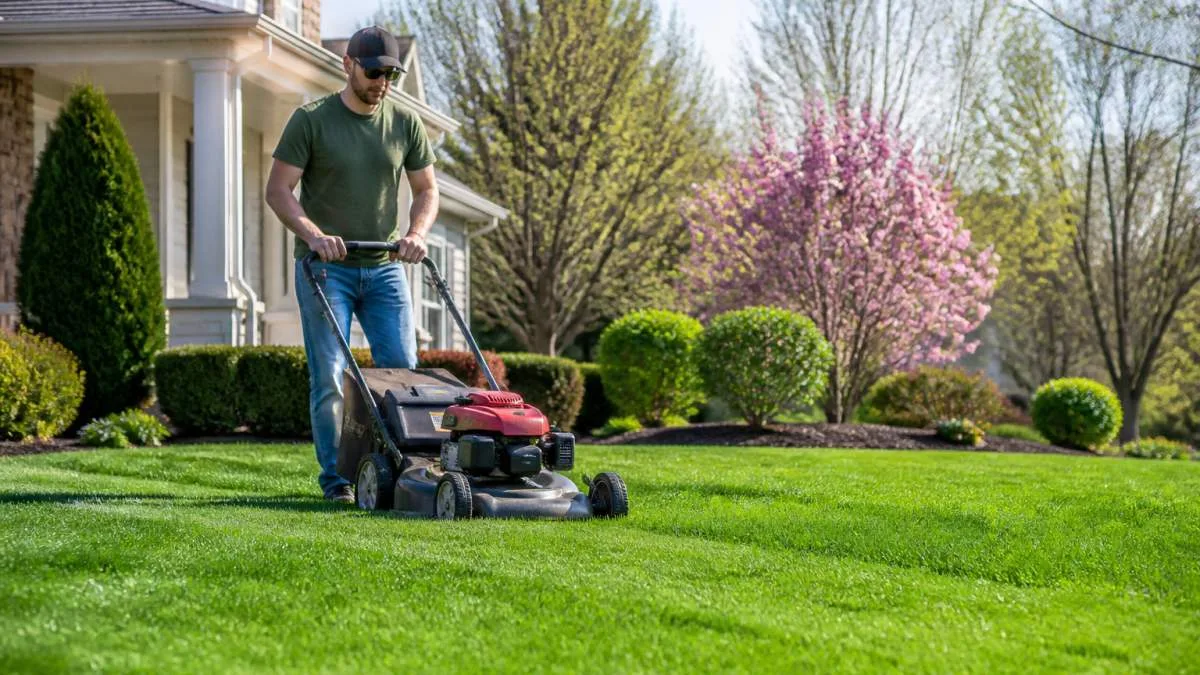
Set your mower high for the first cut. Mowing height matters more than most people realize: taller blades shade the soil, suppressing weeds and improving moisture retention.
Never remove more than one-third of the blade height in a single mowing. Scalping the lawn stresses the grass and opens the door to weeds.
When to Apply Pre-Emergent Herbicide for Crabgrass
Pre-emergent herbicide must go down before crabgrass germinates, not after you see it. The window is tied to soil temperature: crabgrass seeds germinate when soil reaches roughly 55°F for several consecutive days at a 2-inch depth. Miss it and pre-emergent does nothing; apply too early and it breaks down before it’s needed.
The Two Signals That Matter More Than the Calendar
A calendar date is a guess. Two signals are far more reliable:
- Soil temperature at 2 inches. Track it through your state’s extension soil temperature monitoring or a cheap soil thermometer. The trigger is 55°F for four to five consecutive days, not a single warm afternoon.
- Forsythia bloom. In many regions, forsythia drops its flowers right as soil crosses that threshold. It’s a useful backup signal when you don’t have a thermometer, but it varies by cultivar and microclimate, so treat it as a confirmation, not a primary trigger.
Zone-Based Timing Windows
Exact dates shift yearly, but the pattern by USDA Hardiness Zone is consistent enough to plan around:
| USDA Zone | Typical Soil-Temp Trigger | Practical Application Window |
|---|---|---|
| 3-4 | Late April to mid-May | When forsythia is in full bloom |
| 5-6 | Early to mid-April | When soil hits 55°F at 2 inches |
| 7-8 | Mid-March to early April | Often before forsythia opens |
| 9-10 | Late February to mid-March | Track soil temp, not plants |
Warm-season lawns in Zones 8-10 often need a second application 60 to 90 days later, because the barrier breaks down before crabgrass stops germinating. Cool-season lawns in Zones 3-6 usually need one well-timed application.
What to Actually Put Down
Pre-emergent products fall into two main active-ingredient families:
- Prodiamine and pendimethalin form a barrier in the top layer of soil. Water them in within a few days to activate, and don’t disturb them with dethatching or heavy aeration afterward.
- Dithiopyr does the same job but also has some post-emergent activity on very young crabgrass, giving you a small grace period if you’re a week late.
Read the label for rate and watering-in requirements, rates vary by grass species. Do not apply pre-emergent if you plan to overseed within 8 to 12 weeks, because the same barrier that stops crabgrass will stop your new seed.
The most common failure is applying pre-emergent, then dethatching or aerating two weeks later. That breaks the chemical barrier and wastes the entire application. Aerate first, then apply.
When You’ve Already Missed the Window
If crabgrass has sprouted, pre-emergent won’t touch it. Switch to post-emergent control and focus on next season’s prevention, hand-pulling before seed heads form, corn gluten meal as a mild pre-emergent, and thick turf that outcompetes weeds.
One well-timed pre-emergent application at 55°F soil temperature prevents more crabgrass than three late applications combined. Buy a $15 soil thermometer and stop guessing.
How to Get Rid of Crabgrass Naturally
How to get rid of crabgrass naturally comes down to three approaches: hand-pulling before seed heads form, corn gluten meal as a mild pre-emergent for next season, and thick, healthy turf that outcompetes it.
The most effective natural strategy is prevention through turf density. Crabgrass needs bare soil and sunlight to establish. Overseed thin areas in fall, mow high, and water deeply but infrequently, and you’ll see far less of it each year.
| Approach | Best Timing | Effort Level | Realistic Result |
|---|---|---|---|
| Hand-pulling | Late spring to early summer | High | Removes existing plants |
| Corn gluten meal | Early spring, before germination | Low | Mild suppression next season |
| Thick turf / overseeding | Fall | Medium | Long-term prevention |
| Core aeration + overseeding | Early fall | Medium | Reduces bare soil, improves density |
Summer Watering, Mowing, and Stress Management
Summer is where lawns are won or lost. The goal is deep, infrequent watering that pushes roots downward, not shallow daily sprinkling that keeps them near the surface.
Keep mowing at the high end of your grass type’s range during heat stress, raise the deck a notch in July and August.
Watch for lawn dormancy in warm-season grasses and drought dormancy in cool-season grasses. Dormant grass is not dead grass.
Watering every evening for ten minutes is the most common summer mistake. It creates shallow roots, encourages fungal disease, and wastes water through evaporation. Water early in the morning, deeply, and less often.
Best Time to Aerate Lawn and Overseed in Fall
The best time to aerate lawn and overseed is early fall for cool-season grasses, when soil is warm but air temperatures have cooled. New seed then germinates and establishes roots before winter without competing with summer heat or spring weeds.
Warm-season grasses should be aerated in late spring to early summer, when they’re actively growing. Aerating dormant or stressed grass does more harm than good.
Zone-Based Fall Windows
The most useful number is the gap between your last mowing and first frost. Seed needs roughly 45 to 60 days of soil temperatures above 50°F to germinate and tiller before dormancy. Work backward from your average first frost date:
| USDA Zone | Typical First Frost | Best Aerate + Overseed Window |
|---|---|---|
| 3-4 | Mid to late September | Mid-August to early September |
| 5-6 | Early to mid-October | Late August to mid-September |
| 7-8 | Late October to early November | Mid-September to early October |
| 9-10 | November or later | October (cool-season only) |
Find your average first frost date through the National Weather Service frost data, then subtract 45 to 60 days. That’s your target seeding date, not the date on a bag.
Core Aeration vs. Dethatching
They solve different problems. If water runs off instead of soaking in, you need core aeration. If thatch exceeds about half an inch, you need dethatching.
A quick test: cut a small square of turf, lift it, and measure the brown layer between green blades and soil. Under half an inch, leave it, thatch is habitat for beneficial microbes.
The Overseeding Mechanics That Actually Determine Success
Aeration alone doesn’t fix a thin lawn. The holes are the delivery system for seed, and how you seed determines whether you get germination or a bird feeder:
- Seed-to-soil contact is everything. Broadcast seed over the aeration holes, then drag a leaf rake or chain-link fence across the lawn to work seed in. Seed sitting on thatch won’t germinate reliably.
- Match the cultivar to your grass. For cool-season lawns, tall fescue blends and turf-type tall fescue are the workhorses; Kentucky bluegrass is slower to establish but spreads to fill; perennial ryegrass germinates in 5 to 7 days but is less heat-tolerant. For warm-season lawns, overseed with the same species you already have, Bermuda into Bermuda, zoysia into zoysia.
- Seeding rate matters. A typical tall fescue overseeding rate is 4 to 6 pounds per 1,000 square feet on a thin lawn; a full renovation runs higher. Read the bag for the cultivar-specific rate.
- Keep it moist, not soaked. New seed needs light, frequent watering, two or three short sessions a day for two weeks, then taper to deeper, less frequent watering as roots develop.
- Skip the pre-emergent. Pre-emergent applied within 8 to 12 weeks of seeding will kill your new grass along with the crabgrass.
Core aeration followed immediately by overseeding is the single highest-return fall task for a thin lawn. The holes give seed direct soil contact, which dramatically improves germination, but only if you rake the seed in and keep the surface moist for the first two weeks.
When to Skip Aeration Entirely
Aeration is not an annual ritual. Skip it if your soil is loose and crumbly, if you aerated last fall and the lawn is dense, or if you have a warm-season lawn about to go dormant. Over-aerating a healthy lawn opens space for weeds without solving a real problem.
Winter Lawn Preparation and Equipment Maintenance
Winter preparation is about protecting what you built and storing your tools in working order.
Lawn winterization also means clearing leaves and debris so they don’t smother turf under snow. For equipment, this is the season for maintenance you’ll thank yourself for in spring:
- Drain fuel or add stabilizer to mowers and trimmers
- Sharpen mower blades, or have them sharpened, so spring’s first cut is clean
- Clean and oil hand tools before storage
- Inspect and replace spark plugs and air filters
- Store everything dry and covered
A dull blade tears grass rather than cutting it, leaving jagged tips that brown and invite disease.
If maintaining all of this yourself sounds like more than you want to take on, that’s exactly the work we do.
A lawn care schedule only works if someone executes it, season after season, on time, the hard part for most homeowners balancing work, travel, and everything else. Clean Cut Property Maintenance provides comprehensive residential and commercial property maintenance, including expert lawn and plant care, professional tree services, and landscape installation, all through a custom quote built around your property. Get a custom quote from Clean Cut Property Maintenance and let a healthy, well-timed lawn be one less thing on your list.
Frequently Asked Questions
What do I put on my lawn in September?
September is the ideal month for core aeration and overseeding on cool-season lawns, followed by a nitrogen-heavy fertilizer application to support root development before dormancy. A soil test will tell you the exact NPK ratio your lawn needs, but a fall blend higher in nitrogen (like 24-6-12) is common. Keep watering consistently for two to three weeks after overseeding so the new grass establishes before the first frost.
How do I determine if I have cool-season or warm-season grass?
Check which months your lawn looks greenest. Cool-season grasses like tall fescue, Kentucky bluegrass, and perennial ryegrass thrive in spring and fall and go dormant in summer heat. Warm-season grasses like Bermuda, zoysia, and St. Augustine green up in late spring and stay active through summer. If you are unsure, a local extension office or lawn care professional can identify your turfgrass by a sample or photo.
When is the best time to apply pre-emergent for crabgrass?
Apply pre-emergent herbicide when soil temperatures reach 55°F at a 2-inch depth for several consecutive days, which usually happens in early spring before crabgrass seeds germinate. In most regions this falls between late February and mid-April. A second application 6 to 8 weeks later extends control through summer. If you miss the window, you will need post-emergent options instead.
How often should I aerate my lawn for optimal health?
Most lawns benefit from core aeration once a year, ideally in early fall for cool-season grass or late spring for warm-season grass. Lawns with heavy clay soil, frequent foot traffic, or visible soil compaction may need aeration twice a year. Overseeding right after aeration gives seed direct contact with soil, improving germination rates and turf density.
What is the difference between lawn fertilization and weed control timing?
Fertilization feeds the grass and is timed to its active growth periods, typically early spring, late spring, early fall, and late fall. Weed control depends on the product: pre-emergent goes down before weed seeds germinate, while post-emergent is applied when weeds are actively growing. Applying the wrong product at the wrong time can stress turfgrass or waste the application entirely.
Can I handle a full lawn care schedule myself, or should I hire a professional?
A basic mowing, watering, and fertilizing schedule is manageable for many homeowners. The challenge is consistency, especially for aeration, overseeding, pre-emergent timing, and grub control, which all depend on narrow weather windows. If your schedule is tight or your lawn has drainage issues, compaction, or heavy weed pressure, a professional service can cover the entire calendar so nothing gets missed.